
AI Labor Tracker / AI and Language Work
Why One EU Translator Refuses to Fix the Machine's Work
Timothy McKeon lost about 70% of his income when EU translation work dried up, and he still refuses to fix machine output. The data from Europe, Britain and the U.S. shows how common his squeeze is, and who keeps the savings.
22%
Share of independent language professionals who gave a confident yes when asked if freelancing has a sustainable future (European Language Industry Survey 2026, released Mar 2026)
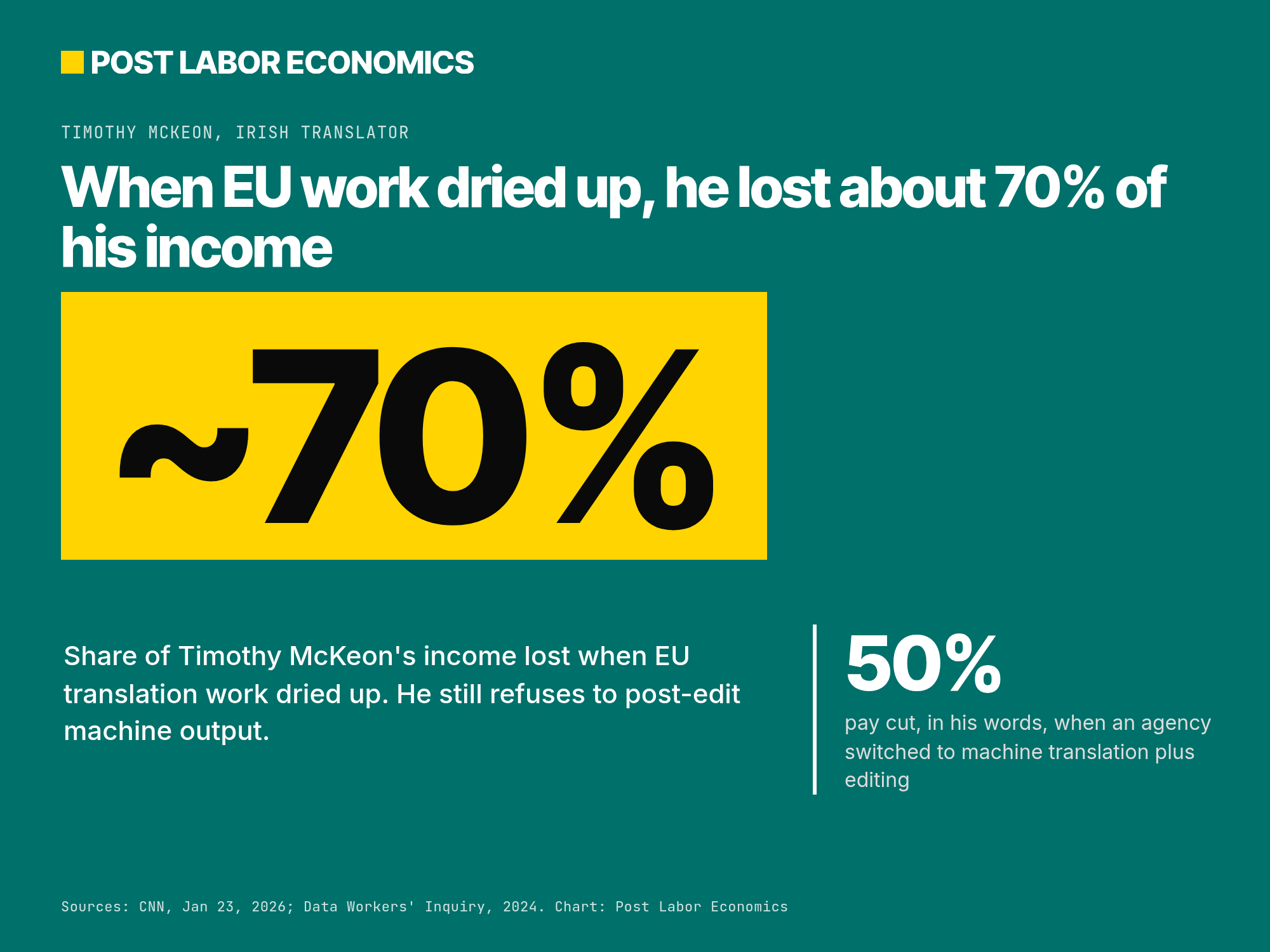
Timothy McKeon translates into Irish, one of the rarest specialties in the European Union. For years, that meant steady work for EU institutions. Then the work dried up, and he lost about 70% of his income, he told CNN in January.
The work that’s left is mostly polishing what a machine already translated.
McKeon refuses it “on principle,” CNN reported, because the corrected text goes back into the software.
“It learns from your work,” he said. “The more it learns, the more obsolete you become. You’re essentially expected to dig your own professional grave.”
He has been saying this for a while.
In a 2024 essay for the Data Workers’ Inquiry, written under the Irish form of his name, Tadhg Mac Eoghain, he described the moment one agency switched all of its German-to-Irish work to machine translation plus human editing. For him, that was “an automatic 50% pay cut.” He told the agency he doesn’t do that kind of work.
“Perhaps I’ve lost that client for good,” he wrote, “but I’m lucky enough to be able to choose my dignity instead.”
A choice most translators can’t make
McKeon’s refusal is a principle. It’s also, by his own account, a luxury.
In the 2024 essay, he said he held “a rather privileged position” because Irish is so rare. He’s also a member of a worker-owned cooperative, the Guerrilla Media Collective.
Even so, he told CNN that everyone in the collective now supplements their income with other work because of AI.
So here’s the question I want answered. If one of the most protected people in the business lost most of his income, what’s happening to everyone else? And when a machine does the first draft, who keeps the money that used to pay the translator?
How typical is McKeon?
Europe has the best data on this, because the industry runs a yearly survey.
The European Language Industry Survey, released in March, drew about 1,000 responses from dozens of countries. More than half came from independent professionals like McKeon.
The mood is grim. Only 22% of the independents gave a confident yes when asked whether freelancing has a sustainable future. About 17% said they’re considering ending their freelance work altogether.
Almost one in two said they’re learning new skills or building another main activity to cope with less work. That’s the Guerrilla Media Collective’s story, at the scale of a continent.
And only about 10% of the independents see any positive effect from AI and machine translation on their work, either as a tool or as a source of new business. The language companies were more upbeat, which makes sense. They’re the ones selling the new product.
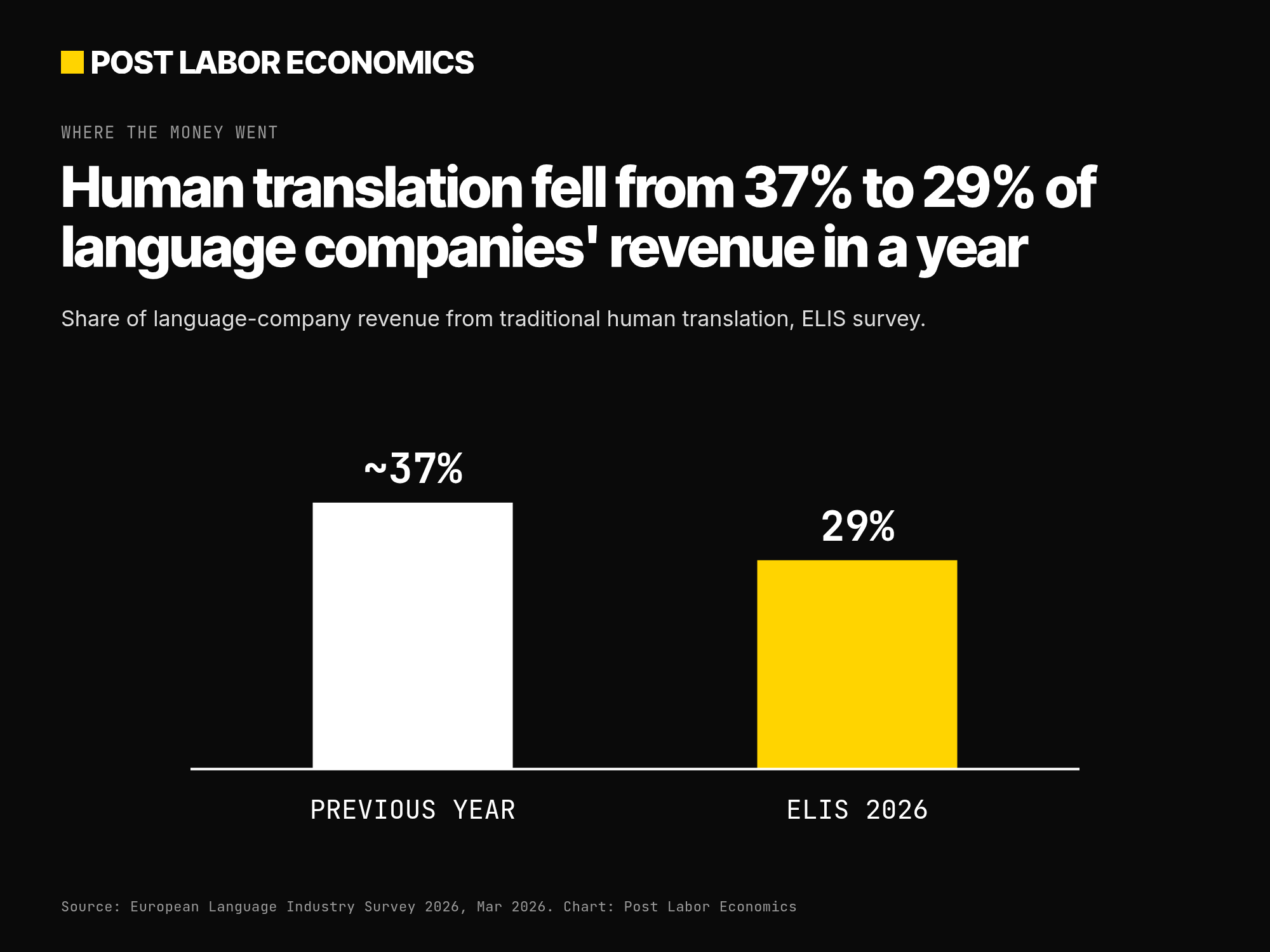
The money is moving. Among language companies, traditional human translation fell from about 37% of revenue to 29% in a year, the survey found. Post-editing, the work McKeon refuses, held at about a quarter.
The survey’s own words on pricing: market rates “did go further down in 2025 and are not likely to increase in 2026.” Among language companies, 62% reported that their local market was shrinking.
Two cautions. ELIS is a volunteer survey, and the report itself warns that some countries sent too few answers to analyze. Treat it as a strong signal from the people closest to the work, not a census.
The same squeeze in Britain and the U.S.
Britain’s Society of Authors surveyed its members in early 2024. About 36% of translators said they’d already lost work to generative AI, and 43% said their income had fallen, the society reported.
More than three in four translators expected AI to hurt their future income. The society later said 78 of its respondents were translators, so it’s a small sample.
Ian Giles, who chairs the society’s Translators Association, told CNN that many translators are looking to retrain “because translation isn’t generating the income it previously did.”
Only 22% of freelance language professionals in ELIS 2026 are confident freelancing is sustainable
Percent of respondents
22%
Share of 564 independent language professionals giving a confident yes that freelancing has a sustainable future, ELIS 2026.
Bar chart. Use the up and down arrow keys to move through 5 categories. A data table follows.
Independents giving a confident yes that freelancing has a sustainable future: Share 22%
- Confident yes: 22%; ELIS's curated figure: 41%
- U.K. sample: 78 translators, January 2024
Figure 1. Selected results from ELIS 2026 (European language industry) and the Society of Authors (U.K., January 2024).
Sources: European Language Industry Survey 2026, March 2026; Society of Authors, Apr 11, 2024. Chart: Post Labor Economics Download CSV Methodology
Data table
ELIS 2026 shares are of 564 independent language professionals, out of 1,058 participants from 45 countries; volunteer survey, report released March 2026. The 22% is the share answering a confident yes; ELIS's curated 41% adds a proportion of don't-know answers. Society of Authors shares are of 78 translators among 787 respondents, surveyed in January 2024. Samples and questions differ, so compare bars within each survey only.
| indicator | Share |
|---|---|
| Independents giving a confident yes that freelancing has a sustainable future | 22% |
| Independents considering ending their freelance activity | 17% |
| Independents seeing any positive effect of AI/MT on their activity | 10% |
| UK translators who had already lost work to generative AI | 36% |
| UK translators whose income fell in value because of generative AI | 43% |
The U.S. looks different on the surface.
The Bureau of Labor Statistics counted about 74,000 interpreters and translators in 2025, and it projects about 2% growth over the next decade. That’s slow, but it’s still growth.
The harder number comes from Oxford.
Economists Carl Frey and Pedro Llanos-Paredes compared U.S. regions by how much they used Google Translate from 2010 to 2023. Regions that used it more saw slower growth in translator jobs, CNN reported.
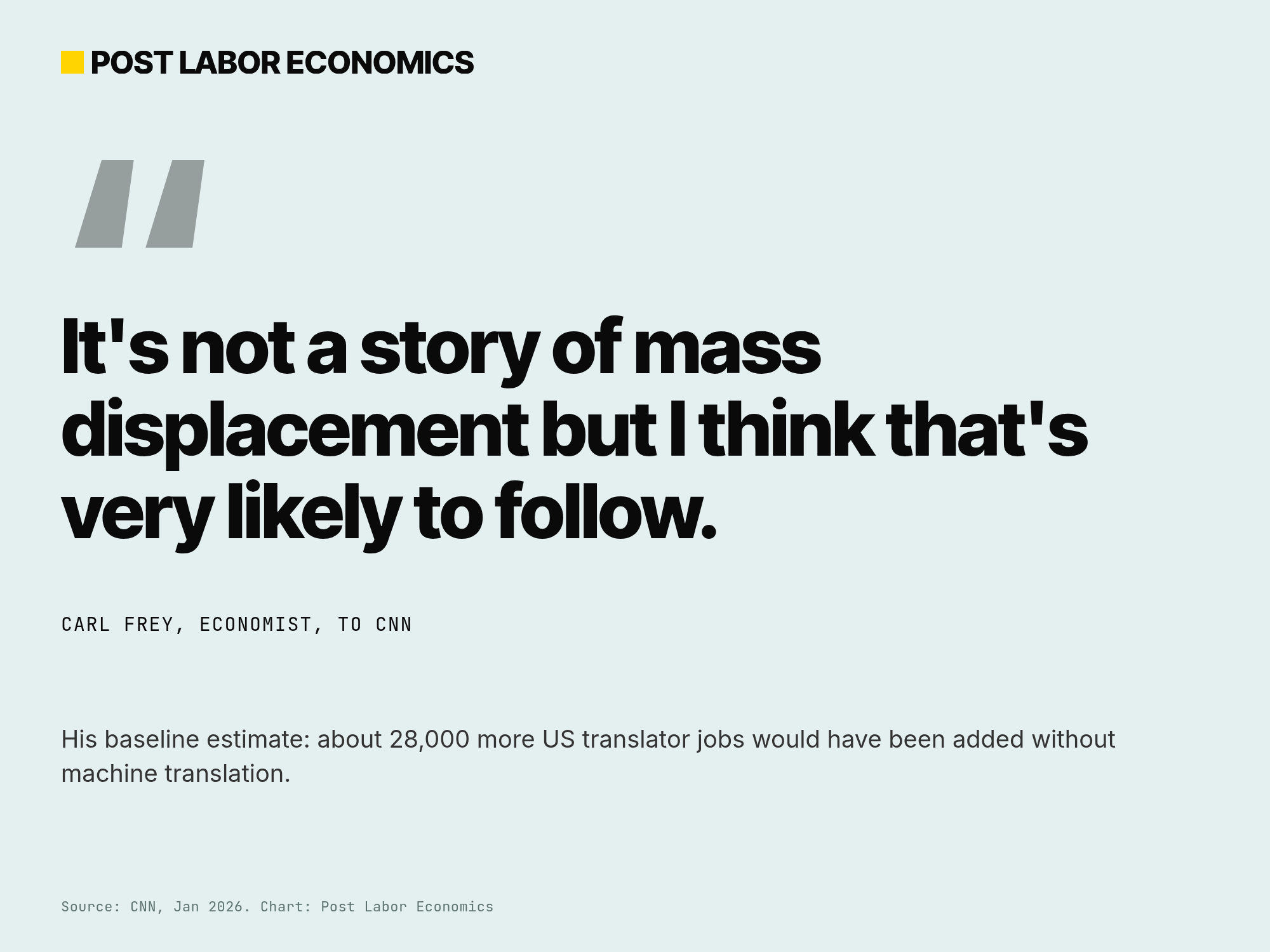
“Our best baseline estimate is that roughly 28,000 more jobs for translators would’ve been added in the absence of machine translation,” Frey told CNN. “It’s not a story of mass displacement but I think that’s very likely to follow.”
So the U.S. head count hasn’t fallen. The work inside it has changed, and the jobs that would have been added never showed up.
What the EU’s own numbers show
Let’s talk about the scary parts. The most striking numbers come from the biggest translation employers of all: governments.
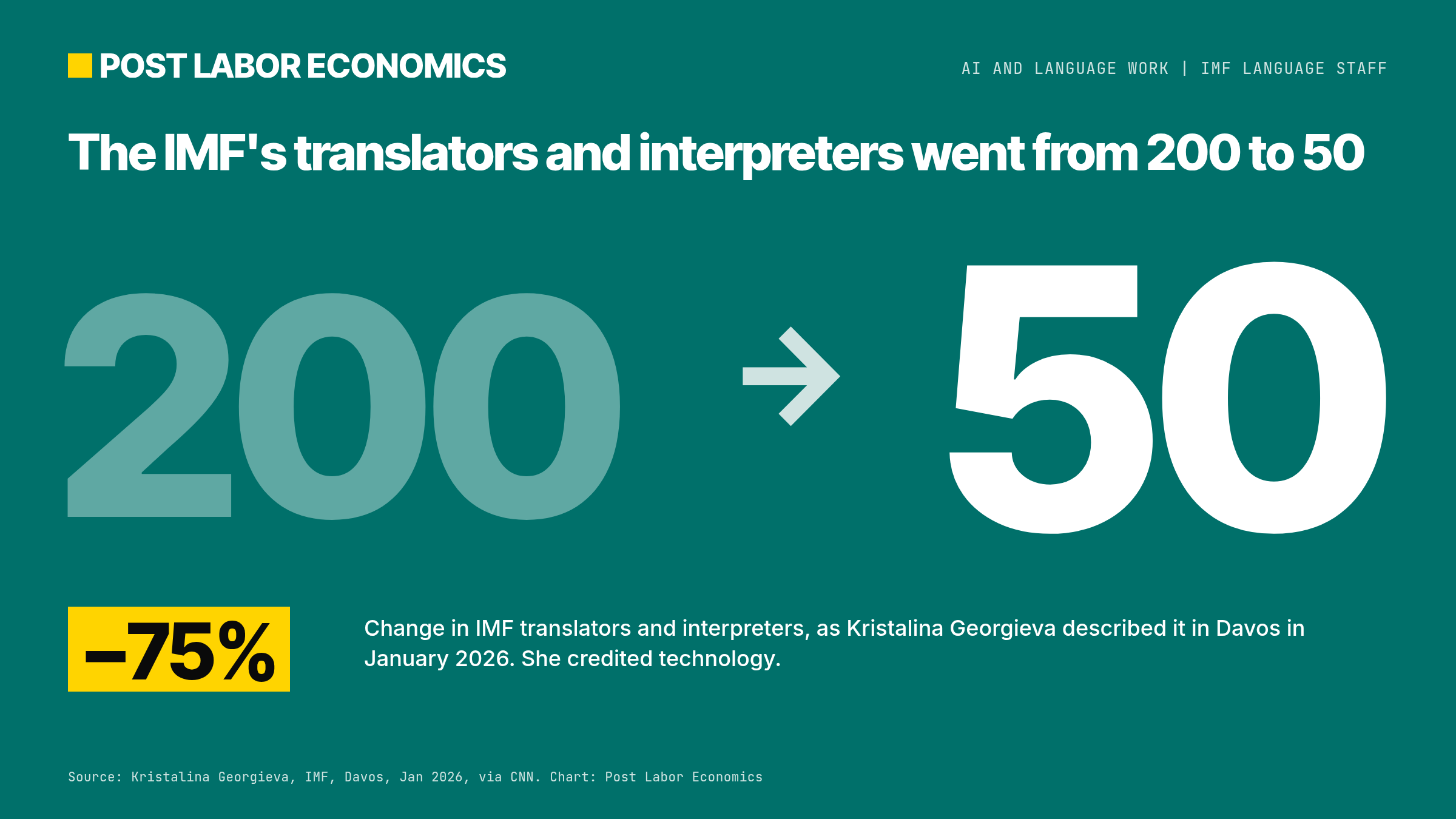
Kristalina Georgieva, who runs the International Monetary Fund, said in Davos in January that the fund’s translators and interpreters had gone from 200 to 50, CNN reported. She credited greater use of technology.
The European Commission is the clearest example of where the savings go.
Back in 2023, Politico Europe reported that the Commission’s translation department had shrunk from about 2,450 permanent staff in 2013 to about 2,000.
Over roughly the same period, the workload rose from about 2 million pages a year to 2.5 million.
That’s the productivity gain in one sentence. Fewer people, more pages.
New translator hires fell to 59 in 2022 from 112 in 2013, Politico reported.
The share of work sent to outside contractors grew from about a quarter to more than a third. A union leader told Politico that burnout and mental health problems rose among staff translators over the same decade, as the workload and pressure climbed.
Those outside contractors are freelancers like McKeon and the agencies that hire them. The Commission’s outsourcing budget grew from about €12.6 million in 2012 to €20.4 million in 2022, by its own figures.
That money was the freelance market. And it’s the part that’s easiest to cut.
In his 2024 essay, McKeon wrote that a Spanish freelancer told him many of her colleagues doing outside work for the Commission had been “abruptly informed” they’d been replaced by eTranslation, the Commission’s own machine translation tool. That’s his secondhand account, and I couldn’t find the Commission confirming it.
Irish looked safe in 2023. A translation professor at Dublin City University told Politico then that “Irish students have loads of offers from DGT all the time.” By this January, McKeon was telling CNN the EU work had dried up.
Politico quoted a translator at the Council of the EU, unnamed in its story: “I already know that I probably won’t be translating for the rest of my life.”
Commission translation staff fell 18% from 2013 to 2023; pages rose 25% from 2013 to 2022
Percent change, base year to latest year
Derived estimate
−18%
Change in permanent Commission translation staff, 2013 to 2023 (about 2,450 to 2,000; Politico says 17%).
Bar chart. Use the up and down arrow keys to move through 3 categories. A data table follows.
Permanent translation staff, 2013 to 2023: Percent change −18.4%
- Recruits: 112 in 2013, 59 in 2022
Figure 2. Percent change in three European Commission translation (DGT) measures, from 2013 to the latest year reported.
Source: Politico Europe, May 12, 2023, citing European Commission figures. Chart: Post Labor Economics Download CSV Methodology
Data table
European Commission figures as reported by Politico Europe, May 12, 2023. Permanent DGT staff: around 2,450 (2013) and around 2,000 (2023); Politico says the unit shrank 17%, and the rounded figures give 18.4%. Pages translated: about 2 million (2013) to 2.5 million (2022). New translator recruits: 112 (2013) to 59 (2022). Latest years differ by measure. Percent changes are my calculation.
| label | Percent change |
|---|---|
| Permanent translation staff, 2013 to 2023 | −18.4% |
| Pages translated per year, 2013 to 2022 | +25.0% |
| New translator recruits per year, 2013 to 2022 | −47.3% |
In his essay, McKeon described what that shift felt like from the freelance end. Work often arrived already 45% filled in from earlier translations stored in the agency’s database, he wrote, and he was still expected to check the whole thing. And he said translators had trained the machines themselves.
“With all of the MTs and evaluations that we provided for free, we were simply digging our own graves,” he wrote. Two years later, he used almost the same image with CNN.
Who keeps the savings
The first winners are the buyers.
A company that used to pay a translator by the word now pays a machine and an editor for less. Agencies call that “post-editing.” On McKeon’s invoice it was a 50% pay cut.
The language companies gain too, at least for now. Post-editing is a steady slice of their revenue, and the ELIS report shows them shifting their growth plans toward it.
Some translators keep their work.
Andy Benzo, president of the American Translators Association, told CNN that human translators will be needed for the foreseeable future in diplomatic, legal, financial and medical work, where the risks of an error are “humongous.”
Giles, who translates Scandinavian fiction into English, said his company work disappeared but his literary commissions kept coming.
That fits an argument I made in Knowledge is free. Creativity isn’t. The dictionary is free. The judgment about what a sentence means in a contract or a courtroom still has a price.
The courtroom is where the fight landed in the U.S. Christina Green, a court interpreter in Wisconsin, told CNN her language company lost a Fortune 10 client to an AI translation vendor and she had to lay off staff. She also fought a state bill that would have let courts use AI or machine translation in place of human interpreters.
The bill passed the Wisconsin Assembly but failed in the Senate on March 19, the American Translators Association reported in May. Green led the opposition as chair of the association’s advocacy committee. The association warned it could come back next session.
Who loses is clearest at the bottom.
It’s the generalist freelancer translating manuals, websites and routine institutional text, whose rates were already flat. McKeon wrote in 2024 that per-word rates had, at best, stagnated for a decade. Now the volume is going too.
Fardous Bahbouh, a London-based Arabic translator who is studying the industry for her PhD, told CNN she worries governments aren’t doing enough to help translators move into other work. Without that, she said, the result “could lead to greater inequality, in-work poverty and child poverty.”
My read: McKeon is right about the mechanism and early on the timing. Post-editing does feed the system that replaces the post-editor, and the EU’s own numbers show the gains going to the institution, in more pages from fewer people.
But refusing the work only protects the people who can afford to refuse, and he’s said himself that he’s one of the lucky ones.
The limit of the evidence is real: the European numbers are surveys of willing respondents, and the U.S. job count is still growing, slowly.
I’d change my mind if the U.S. count started climbing faster than the Oxford estimate says it should.
Where McKeon stands now
The latest public account is CNN’s, from January. McKeon still refuses machine-translation editing, and his collective’s members all take other work to get by. His cooperative’s website lists him as a translator, writer and polyglot based in Berlin, with a master’s degree in Irish translation and editing.
In 2024 he wrote that he could choose his dignity over that agency client “for the time being, anyway.” Two years and most of his income later, he’s still choosing it.
My recommendation, if you translate for a living: move toward the work where a mistake has a cost someone will pay to avoid. That means legal, medical, financial, court and literary translation, and the certifications that prove you can do it. Benzo’s “humongous” risk is your pricing power, so put it in writing when you quote a job.