
AI Labor Tracker
From Warehouse Floor to Robot Repair: Who Gets Amazon's Better Jobs?
Amazon has trained more than a thousand warehouse workers to repair its robots, at higher pay. Its own planning documents also count the hundreds of thousands of people it hopes never to hire.
18%
Projected growth in U.S. jobs for industrial machinery mechanics, 2025 to 2035 (BLS, 2026)
In July 2026, Tristan Buneta graduated from a 12-week robotics course at Vincennes University in Indiana. He had once believed that education beyond high school might not be possible for him, the university reported.
“I look at transformers and electrical motors completely different now,” Buneta said. “I think that is when it clicked, that this is something I can do.”
Describing the difference between the person who started the course and the one who finished it, he used one word: “Unrecognizable.”
Buneta was one of 22 apprentices in VU’s 75th cohort of the Amazon Mechatronics and Robotics Apprenticeship.
Since the fall of 2019, more than 1,395 people have completed VU’s part of the program, the university says.
Another apprentice, who wasn’t named, had come from an Amazon delivery station. “I came in with zero knowledge. And now feel more confident and secure in my abilities to be the best tech I can be,” the student said.
That’s the good version of the robot story. Robots arrive, someone has to keep them running, and a warehouse worker becomes a technician.
The question is how many people get that version. Amazon is building the robot-repair job and, at the same time, planning for a future with far fewer warehouse jobs overall.
What the job is
Amazon’s program has two parts, according to its own page. First come 12 weeks of paid classroom training, with free room and board, at a provider like VU, where apprentices earn four industry certifications and college credit.
Then they move to an Amazon building for 2,000 hours of on-the-job mentoring with an experienced maintenance technician. “No previous technical experience required,” the page says, and finishers get “a guaranteed full-time role” on Amazon’s Reliability and Maintenance Engineering team.
The skills are industrial electricity, mechanical components, fluid power and programmable logic controllers. The work is to “repair, troubleshoot, and support the machines that keep operations running smoothly.”
Clint Daguplo is the kind of graduate Amazon likes to point to. He started as a seasonal associate in July 2020, did the apprenticeship, and became a control systems technician at an Amazon robotics site in Seattle, the company wrote in a 2023 post.
“I was able to earn the certifications needed for a job in robotics, while being paid during the learning and on-the-job training,” he said.
The pay jump is real, by Amazon’s account. The apprenticeship pays hourly wages up to 40% higher than entry-level roles, the company said when it unveiled its most automated warehouse, in Shreveport, Louisiana.
Amazon also reported in 2023 that the program had a 100% conversion rate into job placement and more than 95% retention. Those are the company’s own numbers, and I haven’t found an independent check.
Shreveport, where the robots multiplied
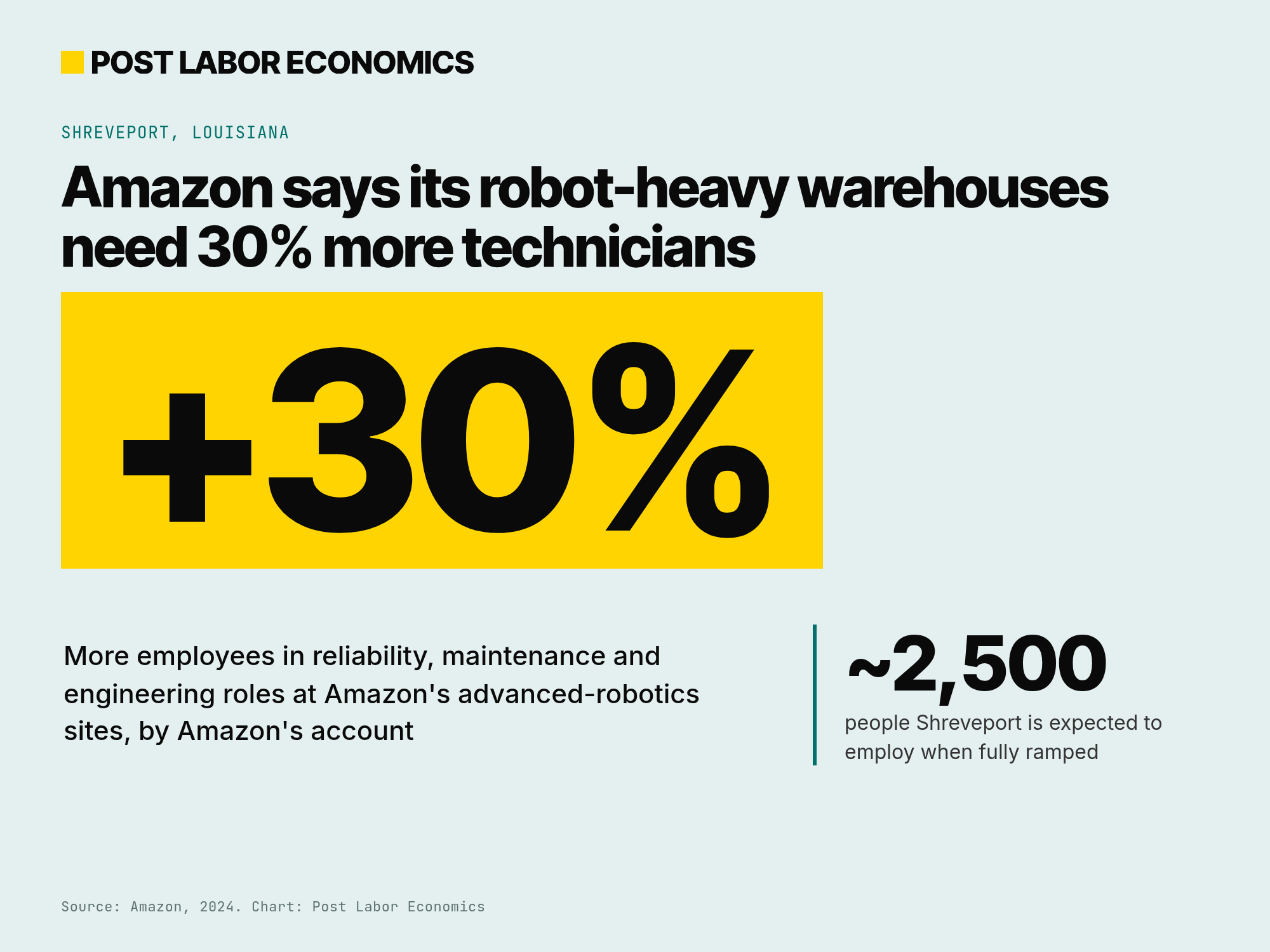
Shreveport is the clearest test of whether robots make jobs. Amazon opened it in 2024 with 10 times more robotics than its earlier buildings, across five floors and more than 3 million square feet.
It expects the site to employ about 2,500 people once it’s fully ramped. And it made a specific promise about the skilled work.
“Our next-generation fulfillment centers and sites with advanced robotics will require 30% more employees in reliability, maintenance, and engineering roles,” Amazon wrote.
That’s 30% more people in maintenance and engineering jobs at those sites. It says nothing about how many pickers, packers and stowers the same building needs, and Amazon didn’t publish a before-and-after headcount for those roles.
The rest of the economy points the same direction. BLS projects jobs for industrial machinery mechanics to grow 18% from 2025 to 2035, in its latest outlook, far faster than the 3% for all jobs.
“The continued adoption of automated manufacturing machinery is expected to create jobs for these workers,” BLS says. Conveyors alone are “likely to be an area of high demand,” because belts, motors and rollers need regular care.
Machinery mechanic jobs are projected to grow 18% from 2025 to 2035; all jobs, 3%
Projected percent change in US employment, 2025 to 2035
+18%
Projected growth in US industrial machinery mechanic jobs, 2025 to 2035, vs +3% for all jobs
Bar chart. Use the up and down arrow keys to move through 7 categories. A data table follows.
Industrial machinery mechanics: Projected change +18%
Figure 1. BLS employment projections for all US employers, 2025 to 2035. Median pay is in the data table.
Source: U.S. Bureau of Labor Statistics, Occupational Outlook Handbook (modified Aug 27, 2026). Chart: Post Labor Economics Download CSV Methodology
Data table
Median pay, May 2025 (BLS): industrial machinery mechanics $64,520; maintenance workers, machinery $60,850; hand occupations $36,280 to $41,220.
| occupation | Projected change |
|---|---|
| Industrial machinery mechanics | +18% |
| Maintenance workers, machinery | −2% |
| Stockers and order fillers | +9% |
| Laborers and freight, stock, and material movers, hand | +2% |
| Packers and packagers, hand | −5% |
| Machine feeders and offbearers | −13% |
| Total, all occupations | +3% |
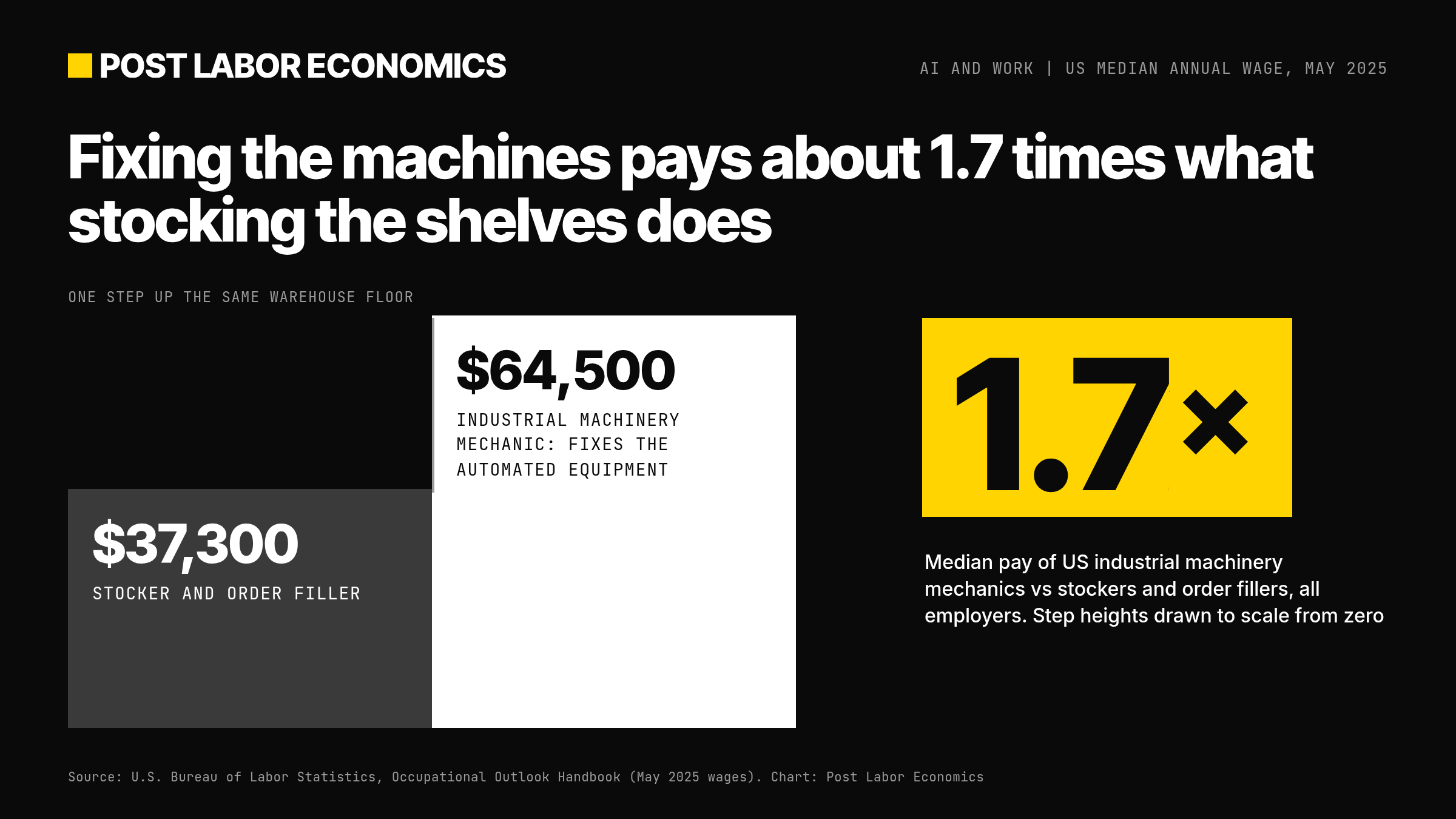
The pay gap is the other half of the chart. The median industrial machinery mechanic earned about $64,500 in May 2025, BLS says. The median stocker and order filler earned about $37,300.
The jobs that robots squeeze hardest are in the same tables. BLS projects hand packers to shrink 5% and machine feeders 13% over the decade, and it says plainly why: technology.
The hires that never happen
Let’s talk about the scary parts. In October 2025, The New York Times reported on internal Amazon strategy documents about automation, as summarized by The Verge.
According to the Times, Amazon’s automation team expected to avoid hiring more than 160,000 US workers by 2027. Executives hoped to avoid hiring more than 600,000 by 2033, even as Amazon sold about twice as many products.
The documents reportedly described a goal of automating 75% of operations. Avoiding those 160,000 hires by 2027 would save about 30 cents on each item, according to the reporting.
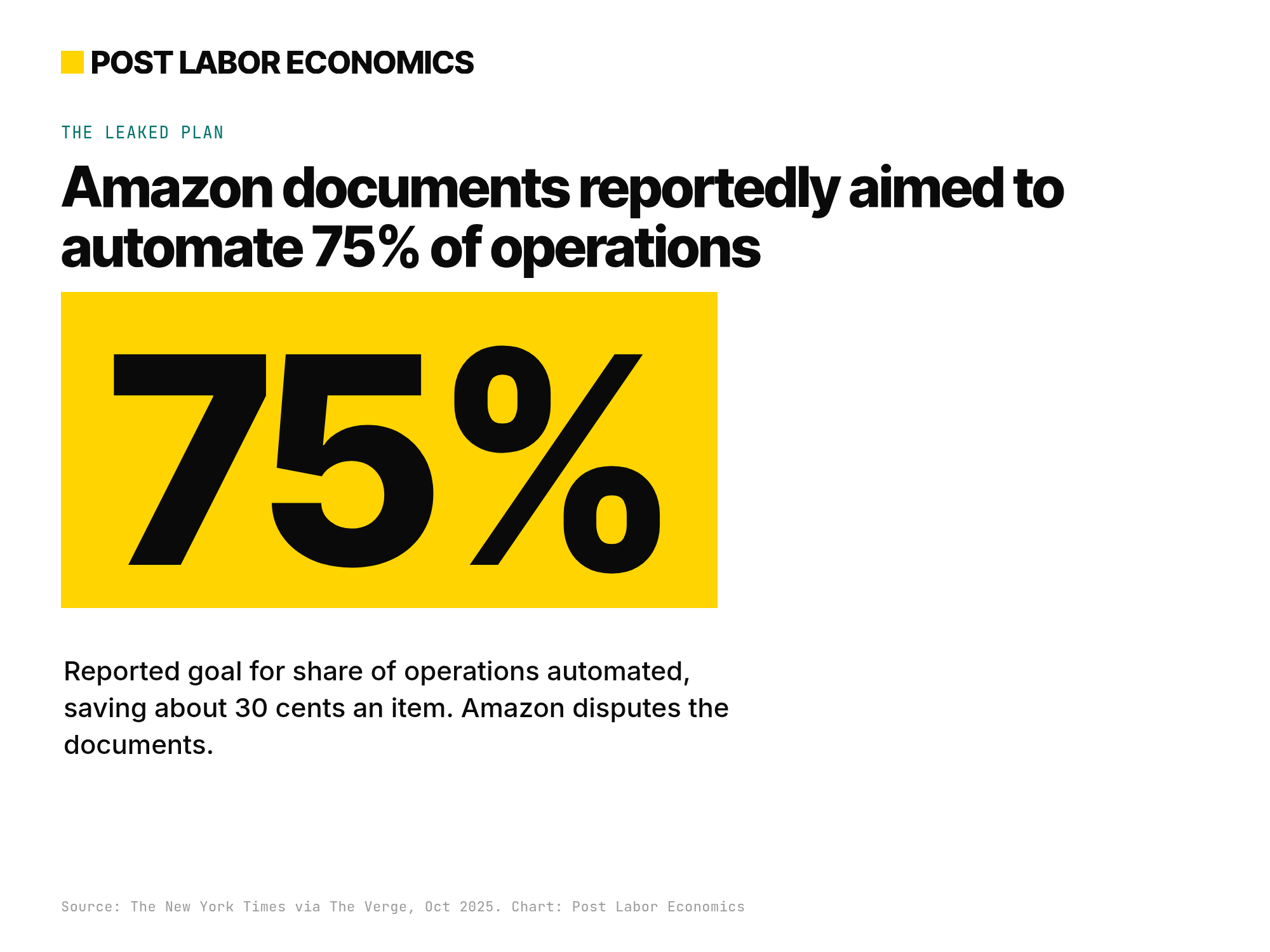
Amazon pushed back. A spokesperson, Kelly Nantel, told The Verge the documents reflected one team’s perspective and didn’t represent the company’s hiring strategy “now or moving forward.”
“Leaked documents often paint an incomplete and misleading picture of our plans, and that’s the case here,” she said. In the company’s “written narrative culture,” she added, “thousands of documents circulate throughout the company at any given time, each with varying degrees of accuracy and timeliness.” That’s a reasonable point, and also a novel defense: we write so many plans that you can’t hold us to any of them.
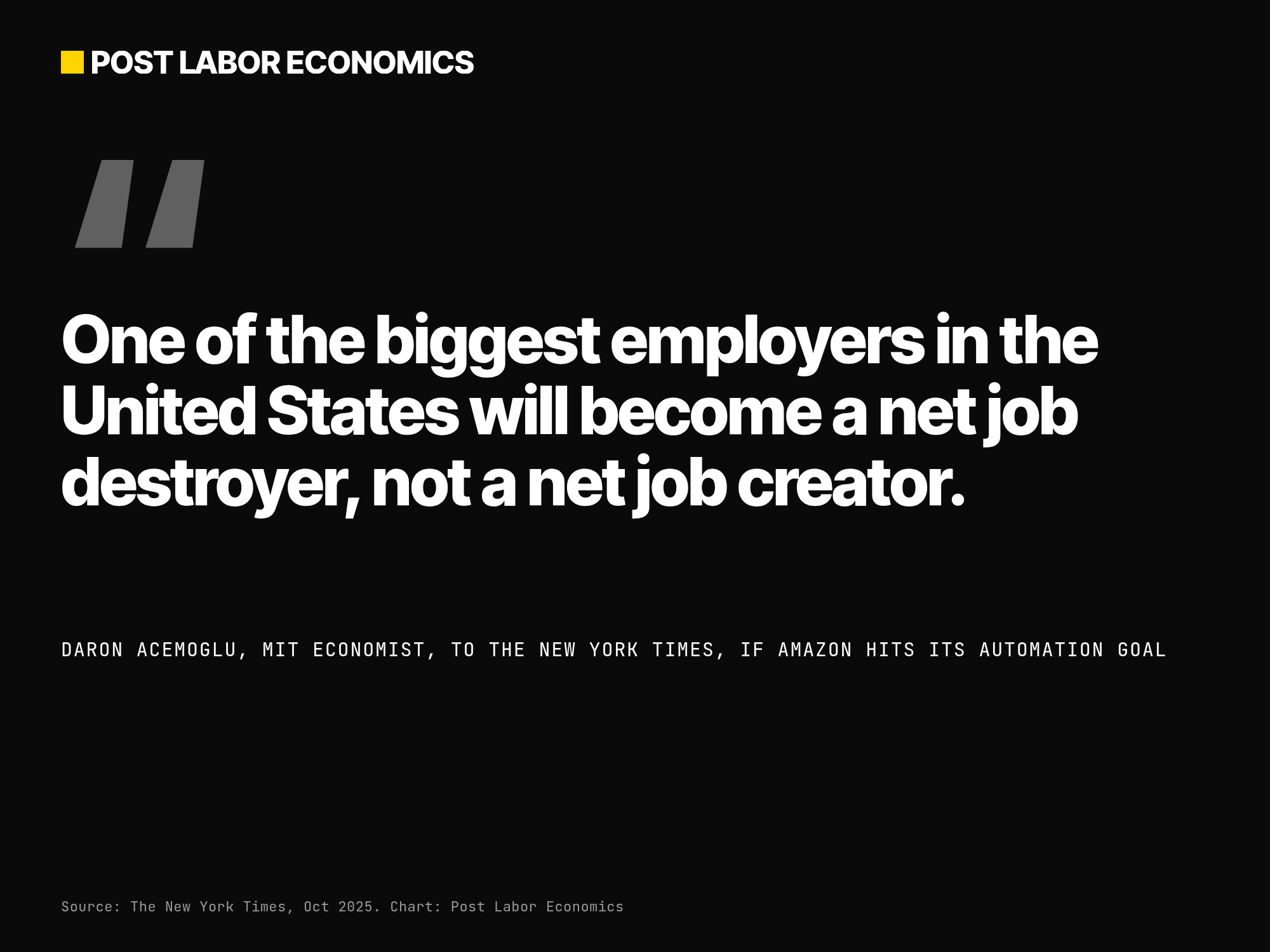
Daron Acemoglu, the MIT economist who shared the 2024 Nobel Prize in economics, told the Times that if Amazon hits its goal, “one of the biggest employers in the United States will become a net job destroyer, not a net job creator.”
This year, Business Insider found the next target. Amazon is piloting software called Full Facility Load Balancing, which recalculates staffing about every three minutes and recommends moving workers between roles as workloads shift, according to internal documents BI reviewed in June.
Early estimates said it could cut almost 7 million labor hours and about $193 million in labor costs a year.
Amazon’s spokesperson told BI the numbers were “incomplete and misleading” because they represent “theoretical modeled opportunities and aspirational targets based on hypothetical analysis.” The spokesperson also said managers remain the decision-makers on staffing.
Amazon’s executives don’t hide the tension. “We will need fewer people doing some of the jobs that are being done today, and more people doing other types of jobs,” CEO Andy Jassy wrote in a 2025 memo to employees about Amazon’s corporate workforce, as quoted by CNBC.
Tye Brady, chief technologist at Amazon Robotics, gave CNBC the other side: “Since we’ve invested in robotics, we’ve created hundreds of thousands of jobs.” Both statements can be true at once, for different people.
So here’s the shape of it. Robot fixers are a growing, better-paid job, and Amazon is training people for it. The company’s own planning, at least in some teams, also counts on needing far fewer of the people who do everything else.
Amazon's training and job pledges run in the thousands. Its avoided hires reach 600,000 by 2033.
Number of people
600,000+
US hires Amazon hoped to avoid by 2033, per leaked plans it disputes
Bar chart. Use the up and down arrow keys to move through 5 categories. A data table follows.
Vincennes University Amazon apprenticeship completers: People 1,395
Figure 2. Different measures and periods, not a subtraction. Avoided hires come from documents Amazon disputes.
Sources: Vincennes University, Jul 9, 2026; CNBC, Jun 5, 2026; Amazon, Jun 4, 2026; The Verge, summarizing The New York Times, Oct 21, 2025. Chart: Post Labor Economics Download CSV Methodology
Data table
| measure | People | Note | Source |
|---|---|---|---|
| Vincennes University Amazon apprenticeship completers | 1,395 | One training provider's count of classroom-phase completers, not Amazon's whole program; VU says over 1,395. | Vincennes University |
| Amazon UK apprenticeships created | 6,000 | Apprenticeships of all types in the UK, not only robot technicians; CNBC says over 6,000. | CNBC |
| Planned European fulfillment workforce growth | 25,000 | A planned increase in Europe's fulfillment-center workforce, all roles, alongside a more than €10 billion robotics investment. | Amazon |
| US hires Amazon's automation team expected to avoid by 2027 | 160,000 | US hires the automation team expected to avoid by 2027, per documents reported by the NYT; Amazon says they reflect one team, not its hiring strategy. | New York Times via The Verge |
| US hires avoided by 2033 if sales double | 600,000 | US hires executives hoped to avoid by 2033 while selling about twice as many products, per the NYT; Amazon disputes the documents. | New York Times via The Verge |
My read: the robot-fixer job is real and good, and it’s not going to absorb everyone the robots displace. Vincennes’s completers number in the low thousands, a different order of magnitude from avoided hires in the hundreds of thousands.
The honest limit is that the 600,000 figure is a leaked projection Amazon disputes, and avoided hires aren’t layoffs. Amazon still said it planned 250,000 holiday hires last year.
Europe makes the same bet, out loud
Amazon’s pitch is the same across the Atlantic. In June, it said it would invest more than €10 billion in European fulfillment centers with new robotics, and grow that workforce by 25,000 over the coming years.
“Our experience of robots is that it’s actually driven up employment rather than the reverse,” John Boumphrey, Amazon’s vice president and country manager for the U.K. and Ireland, told CNBC.
He said Amazon “cannot find enough people to do the skilled jobs that we need,” from robotic technicians to mechatronic engineers. He called the more than 1 million young Britons not in education, employment or training a “national crisis,” with too many young people unprepared for work.
The company says it has created more than 6,000 UK apprenticeships and gives staff £3,000 a year to train on nationally recognized courses.
How typical is that? The skills shortage claim lines up with the BLS outlook in the U.S., which expects about 51,900 openings a year for machinery mechanics, maintenance workers and millwrights combined.
It lines up with what I hear, too. We work a lot with home service companies, and they are dying for more techs. And that’s one of the best jobs.
There are some really amazing jobs out there you don’t have to go to college for.
The UK numbers aren’t comparable to the U.S. ones, so I won’t set them side by side. Amazon reports apprenticeships of all types there, and no country-level count of robot technicians.
Who loses and who gains
The people who gain are the ones like Buneta and Daguplo: warehouse or delivery workers with a mechanical streak who get paid to learn a trade, and come out with certifications that work anywhere a conveyor runs.
The people who lose are mostly people you’ll never meet. They’re the workers Amazon hopes it won’t need to hire by 2033, in the towns where it used to be the big new employer. Nobody gets a layoff letter for a job that was never posted.
In between are current pickers and packers. Software like FFLB leaves them in the building and shifts them between roles as the workload changes, so the building needs fewer of their hours.
In my opinion, the fair test of Amazon’s “robots create jobs” line is simple, and Amazon could publish it tomorrow: total hourly headcount and hours per package shipped, by building, before and after automation. Until then, the technician numbers are the half of the ledger that flatters the company.
Where Buneta is now
VU’s announcement is the last public word on Buneta. He finished the classroom phase in July with the 75th cohort; under Amazon’s program design, that’s followed by 2,000 hours of mentored work in an Amazon building and a guaranteed full-time technician role.
Amazon, meanwhile, keeps building. The 2027 and 2033 goals in its internal documents haven’t been withdrawn, only disputed.
If you work in a warehouse with robots, here’s my one recommendation: get on the list for the maintenance apprenticeship now, while the company is paying for the training and the trade is short of people. The building will always need someone who can fix the machines; it may not need as many people to work beside them.