
AI Labor Tracker / AI and Medicine
AI Was Going to Replace Radiologists. Now There Aren't Enough
New York's public-hospital chief says AI could replace a great deal of radiologists. The data from the U.S., Britain and Sweden says the shortage is the bigger story, and points to who would really lose.
32%
UK shortfall of clinical radiology consultants in 2025, up from 29% in 2024 (Royal College of Radiologists, 2025 workforce census)
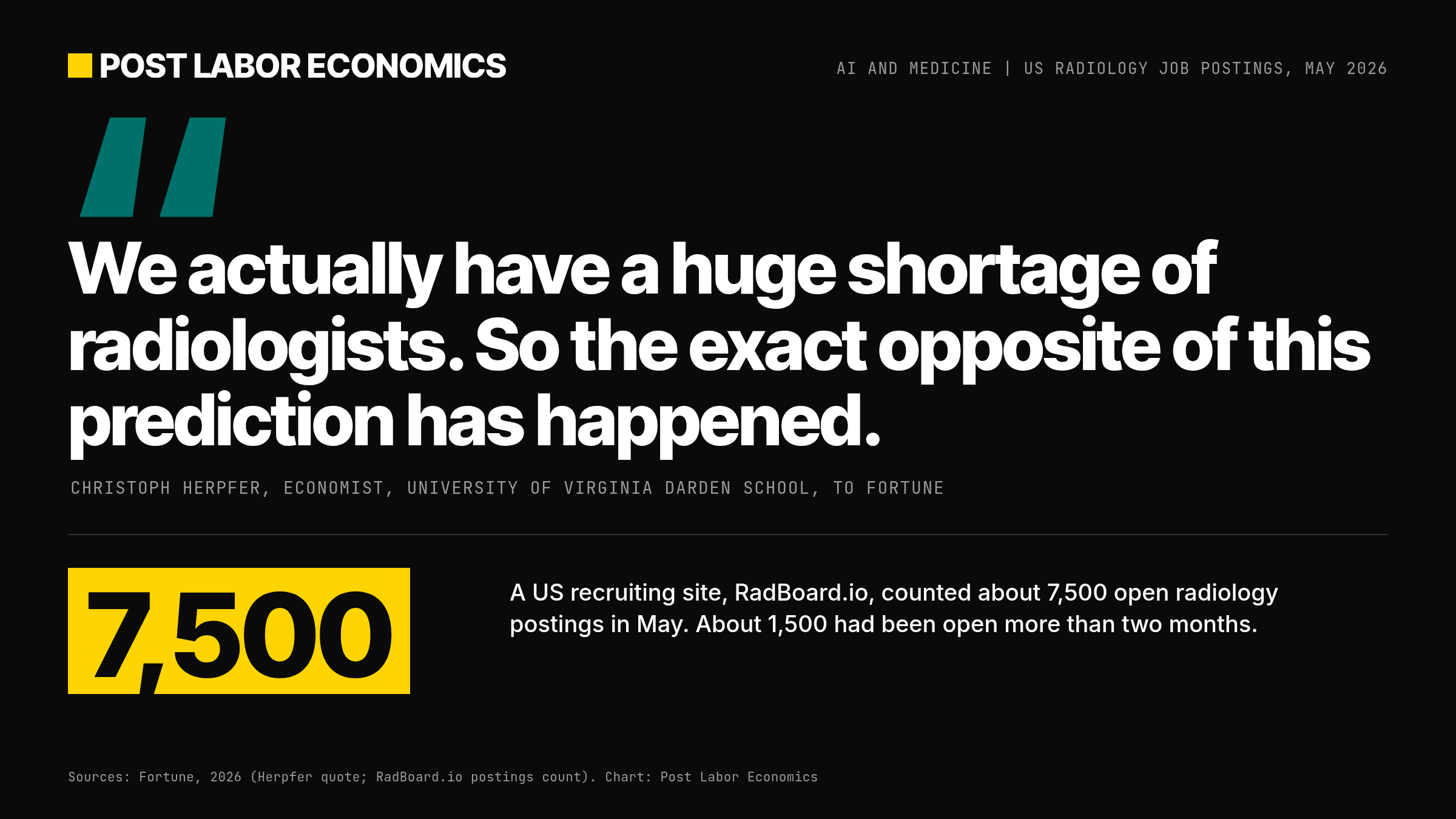
On March 25, Dr. Mitchell Katz, who runs NYC Health + Hospitals, sat on a panel hosted by Crain’s New York Business and said what a lot of hospital executives may have been thinking. “We could replace a great deal of radiologists with AI at this moment, if we are ready to do the regulatory challenge,” he said, Nurse.org reported.
Katz runs the largest public hospital system in the country, 11 hospitals serving more than a million New Yorkers a year, according to Nurse.org. He described AI doing the first read of mammograms and X-rays, with radiologists checking only the abnormal findings, and said it could bring “major savings.” He asked the other hospital chiefs on the panel whether they should push New York to change its rules so AI could read images “without a radiologist.”
They were open to it.
Dr. David Lubarsky, who runs the Westchester Medical Center Health Network, said his system’s AI breast screening, for women who aren’t high risk, is wrong on a negative result “only about 3 times out of 10,000.” He called the technology “actually better than human beings.”
Dr. Sandra Scott of One Brooklyn Health said: “I mean, I’m in charge of a safety-net institution. It would be a game-changer.”
Radiologists answered fast. “Any attempt to implement AI-only reads would immediately result in patient harm and death, and only someone with zero understanding of radiology would say something so naive,” Dr. Mohammed Suhail, a radiologist in San Diego, said, as TechSpot and Nurse.org reported.
Ten years after the coyote
Here’s why this panel matters. Radiology is the job AI was supposed to take first.
In 2016, Geoffrey Hinton, one of the founders of modern AI, said people should stop training radiologists. “If you work as a radiologist, you’re like the coyote that’s already over the edge of the cliff but hasn’t yet looked down,” he said, as Fortune recounted this year.
Hinton has since stepped back. Last year he clarified that he was talking only about image analysis, and said radiologists will work with AI, Fortune reported, citing the New York Times. Ten years later, a hospital chief is saying the original version out loud in public.
So I want to answer two questions. Is radiology a job with too many people, or too few? And if Katz got his way, who would gain and who would lose?
The shortage, in plain numbers
Start in the U.S.
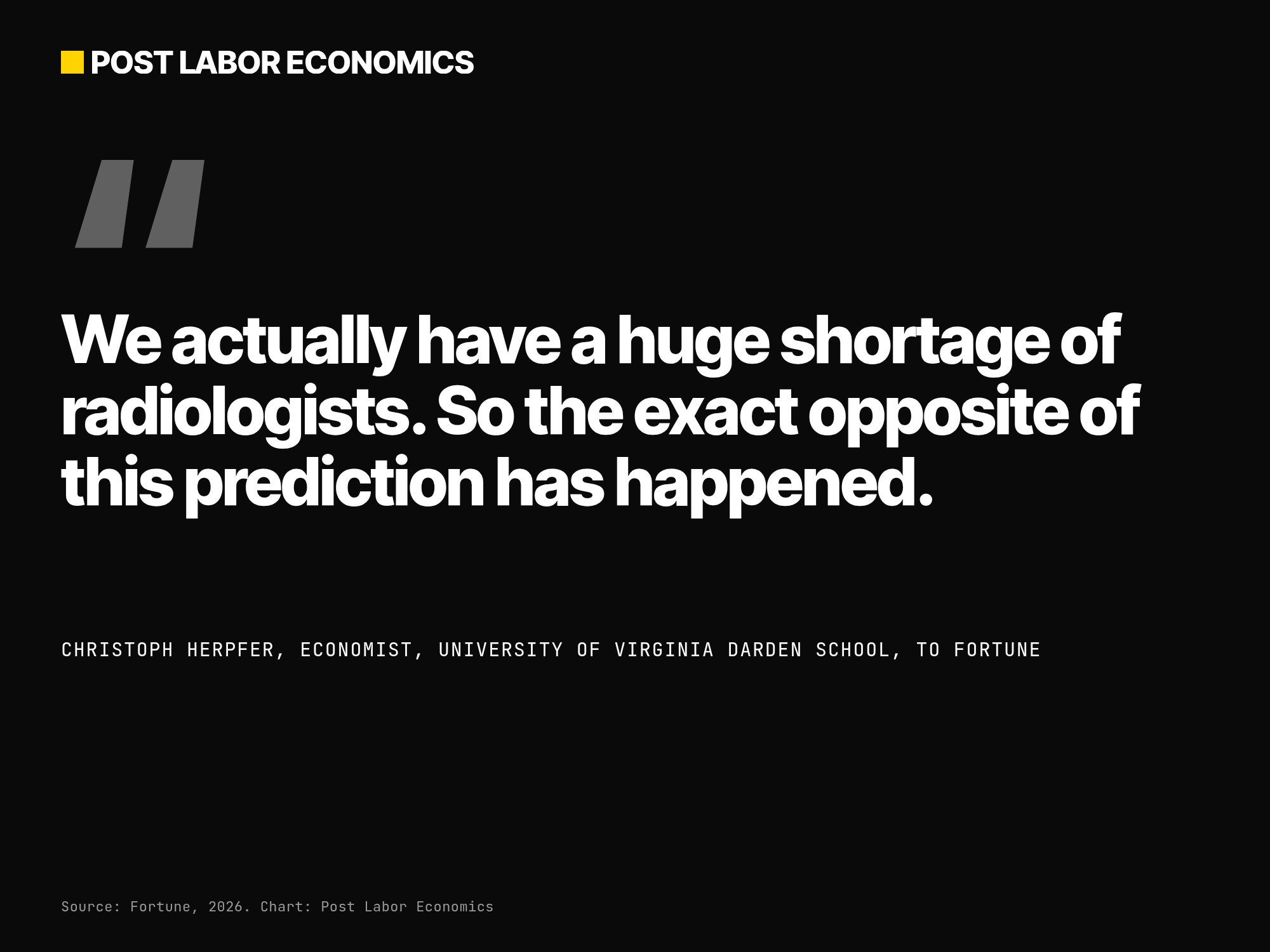
The number of active radiologists has grown by about 10% over the last decade, according to Christoph Herpfer, an economist at the University of Virginia’s Darden School who studies physician labor markets. “We actually have a huge shortage of radiologists. So the exact opposite of this prediction has happened,” he told Fortune.
A different count, from the American College of Radiology’s research institute, puts the growth at about 17% from 2014 to 2023, the ACR Bulletin reported in February. The two counts measure different groups over different years, but they point the same way: up.
The jobs aren’t getting filled. The recruiting site RadBoard.io counted about 7,500 open radiology postings in May, and about 1,500 of them had been open for more than two months, Fortune reported.
When something is short, the price goes up. Medscape found the average radiologist earned about $571,000 in 2025, up 9% in a year.
Demand keeps outrunning the people. Radiology caseloads rose about 25% from 2018 to early 2025, according to the Journal of the American College of Radiology. And radiologists are leaving faster than they used to.
The ACR Bulletin reports that the share of radiologists leaving the workforce each year rose from about 1.1% in 2014 to about 2.5% in 2022.
The same research projects the radiologist workforce growing about 21% by 2055, while demand for some scans, such as CT, grows faster, up to 25%.
Federal projections agree: the Health Resources and Services Administration expects the supply of radiologists to cover only about 90% of demand in 2038, the Bulletin noted.
U.S. radiologists are leaving the workforce faster
Percent leaving the workforce per year
2.3×
US radiologist attrition rate, 2022 vs 2014.
Line chart. Use the left and right arrow keys to move through 3 periods. A data table follows.
2022: Attrition rate 2.5%
- In 2022, about 1 in 40 radiologists left
Figure 1. Annual attrition rate of US radiologists. Three published points; the lines between them are not yearly data.
Source: ACR Bulletin (Feb 5, 2026). Chart: Post Labor Economics Download CSV Methodology
Data table
1.1% (2014), 2.0% (2019), 2.5% (2022). 2.5 / 1.1 = 2.27. 1 / 0.025 = 40.
| year | Attrition rate |
|---|---|
| 2014 | 1.1% |
| 2019 | 2.0% |
| 2022 | 2.5% |
What the workload looks like from the reading room
The numbers above come from economists and trade groups. The people doing the reads tell the same story, with less polish.
Dr. Jeff Chang spent a decade as an emergency radiologist reading 150 to 200 studies on each night shift, Fortune reported.
“The number of studies that a radiologist has to do every year keeps going up, the reimbursement keeps going down, and they just get really, really burnt out,” he said.
Chang cofounded Rad AI, a startup that writes the conclusions section of reports to save radiologists close to an hour a shift. Even so, he said replacing radiologists “didn’t really make sense to begin with.”
Dr. Tonie Reincke, an interventional radiologist in Texas, put the part of the job a scan doesn’t show this way: “A computer can’t hold a patient’s hand when they’re crying. A computer can’t hand them a tissue.”
She told Fortune she worries the replacement talk will scare medical students away from a residency that already takes five or six years.
Herpfer’s explanation of why the job survives is the one I find most useful.
Reading images is one task of many. Radiologists also consult with other doctors, monitor patients and, in some specialties, do procedures. “Even if you can automate one or two of those, you just expand the time you spend on the other tasks,” he told Fortune.
He compared it to accountants, who were expected to be wiped out by spreadsheet software in the 1990s. Excel took the routine number-crunching, and accountants moved into more complex advisory work.
There’s also a rule in the way. Medicare and Medicaid only pay for a radiology study when a licensed physician does the final read, Fortune noted. That’s the “regulatory challenge” Katz was talking about.
Britain is shorter still.
The best international comparison comes from the U.K., where the Royal College of Radiologists counts the gap every year. Its 2025 census found a 32% shortfall of radiology consultants, up from 29% the year before.
That’s more than 2,300 full-time doctors short of safe care, the college says.
The college says the gap will reach 40% by 2030 if nothing changes.
The reason is simple arithmetic. Over the past five years, complex scans grew almost 6% a year, and the workforce that reads them grew about 4%.
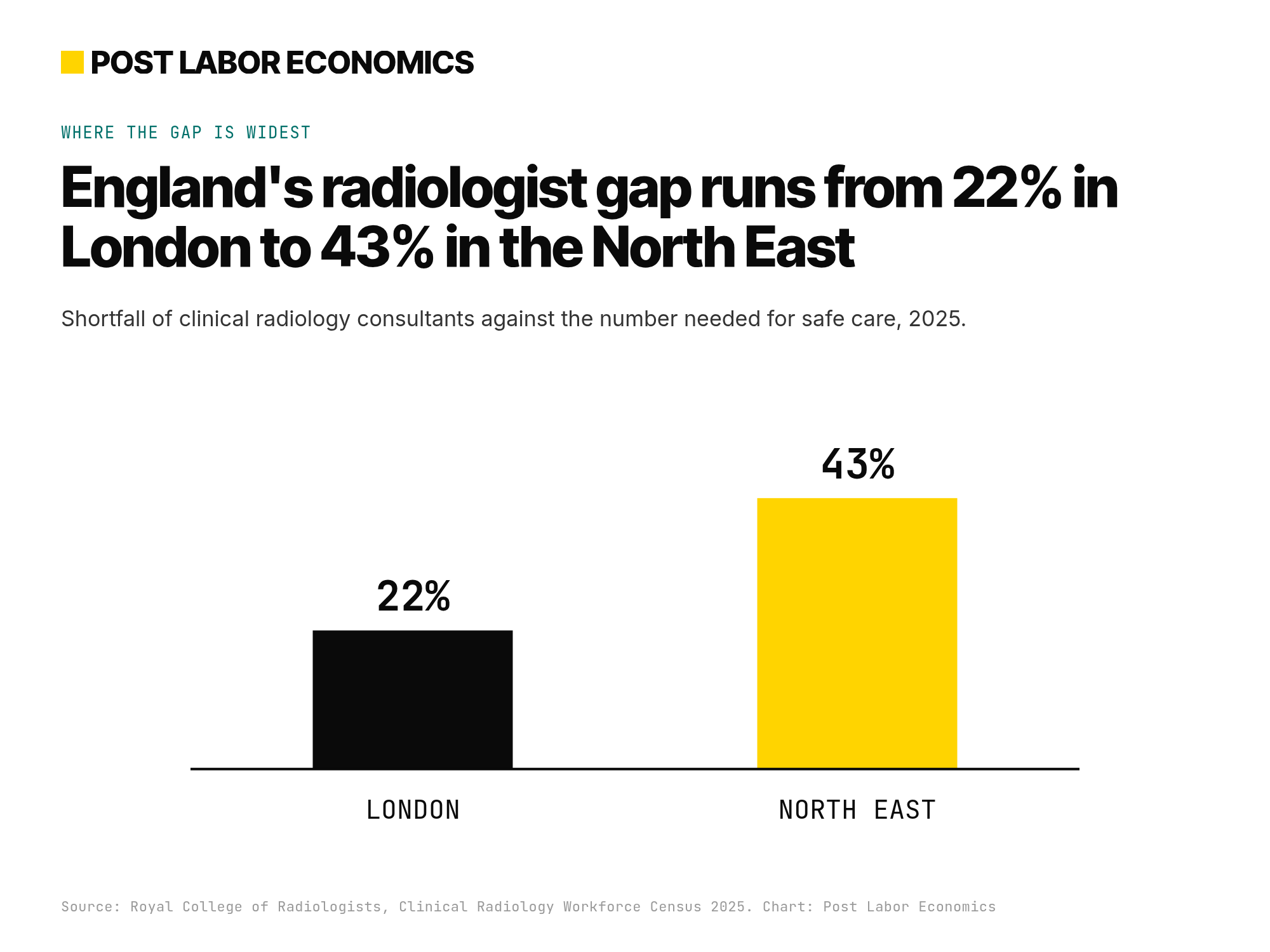
The gap isn’t even. In England, it runs from about 22% in London to 43% in the North East, the census says. Teaching hospitals, which the college notes are generally better resourced, run a smaller gap than small local hospitals.
The money is going somewhere. The NHS spent about £362 million in 2025 on outsourcing, temporary staff and extra paid sessions to keep up with reads, more than twice what it spent in 2021.
About four in five clinical directors told the college they knew of patients whose condition had worsened because of radiology delays.
One clinical director put it simply in the census: “It feels like a constant battle to keep on top of our work.”
The UK's radiology consultant shortfall reached 32% in 2025
Percent shortfall of clinical radiology consultants
32%
The UK's shortfall of radiology consultants in 2025.
Bar chart. Use the up and down arrow keys to move through 3 categories. A data table follows.
2024: Shortfall 29%
- About 2,300 more consultants needed; 40% short by 2030 if nothing changes
Figure 2. UK radiology consultant shortfall, RCR estimate; 2030 if nothing changes. The method has changed, so compare years loosely.
Source: Royal College of Radiologists, Workforce Census 2025. Chart: Post Labor Economics Download CSV Methodology
Data table
RCR 2025 census: 32% shortfall, 2,313 WTE needed; 29% in 2024; 40% forecast for 2030; England 33%, other nations 28%. RCR: 32% is the largest since at least 2019. Consultants in post: 4,396 WTE. RCR does not state the base of the 32% (2,313 / (4,396 + 2,313) = 34.5%), so the title keeps RCR's wording.
| year | Shortfall |
|---|---|
| 2024 | 29% |
| 2025 | 32% |
| 2030 (forecast) | 40% |
I couldn’t find a comparable, current workforce count for most other countries.
The U.S. has projections and job postings, the U.K. has a yearly census, and most of Europe has neither in a form you can line up side by side. That’s a gap worth naming.
What AI actually did in Sweden
Here’s where Katz’s idea gets its strongest evidence, and it deserves a fair hearing. The upside is real.
Sweden ran a large randomized trial, called MASAI, with about 106,000 women in its national breast screening program. In Sweden, two radiologists normally read every mammogram. In the trial, AI sorted the scans: low-risk ones got a single radiologist, higher-risk ones got two, and the AI flagged suspicious spots for the readers.
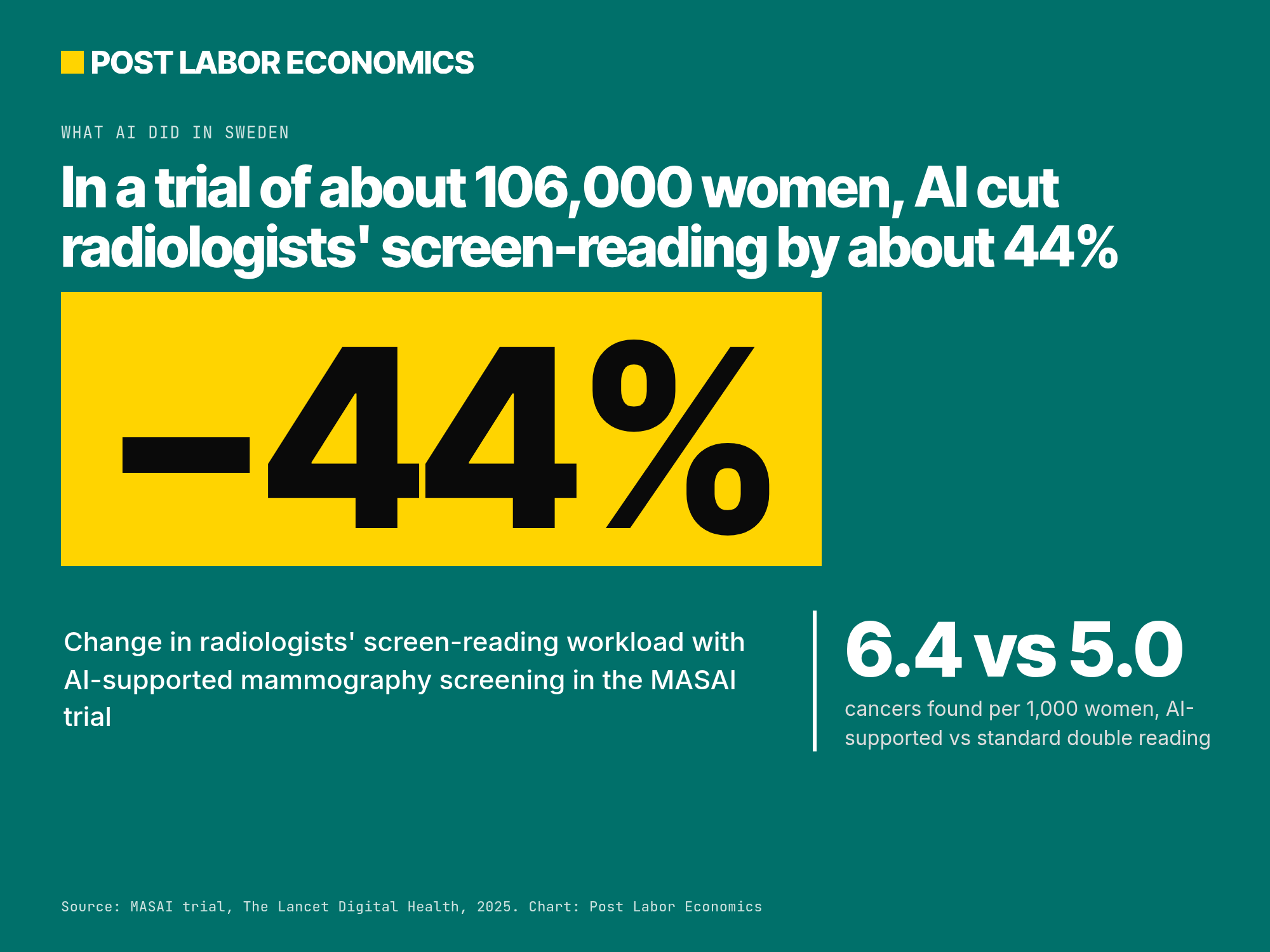
The results were good. The AI-supported group had a cancer detection rate of about 6.4 per 1,000 women, against 5.0 with standard double reading, the Lancet Digital Health paper reported in 2025.
And the radiologists’ screen-reading workload fell by about 44%.
A follow-up in The Lancet this year checked the cancers that show up between screenings, the ones a screen misses. The AI group did no worse, and the AI-supported screening caught a higher share of cancers overall, with the same rate of false alarms.
Now look at what the AI replaced.
It didn’t remove the radiologist. It removed the second radiologist on low-risk scans, in a country that uses two. Every scan in the trial still had at least one human read.
That’s very different from what Katz described: AI reading mammograms “without a radiologist,” in a country where one radiologist per scan is already the norm. The Swedish evidence supports AI as the second reader. It doesn’t test AI as the only one.
Who gains, and who pays
If AI cuts reading time, the first winners are patients waiting for results and radiologists drowning in caseloads. In Britain, it could mean less of that £362 million going to outsourcing. Fewer missed cancers would be the biggest gain of all.
Hospitals gain too, and Katz was honest that savings are the point. His system and One Brooklyn Health serve many of the city’s poorest patients. A safety-net budget is tight, and Scott’s comment came from that pressure.
But follow the risk.
If AI-only reads ever happen, I’d expect them first where money is shortest. That means safety-net hospitals like Katz’s, and places like the small local hospitals and England’s North East, where the U.K. census shows the biggest gaps.
The people with the most to lose from a missed read are the ones least able to buy a second opinion.
There’s one more caution about the vendors. Stanford researchers found leading medical imaging models can describe findings on X-rays they never actually looked at, Nurse.org reported, and one model scored at the top of a chest X-ray benchmark without viewing a single image. That’s one way to cut reading time.
In my opinion, Katz is right that AI will take over a lot of reading, and wrong about who it replaces first. The data says radiology is short of people almost everywhere anyone counts.
The best trial so far used AI to cover the gap, by replacing a second human read, and found more cancers. My honest limit: that’s one country’s trial in one kind of scan, and nobody has yet tested AI-only reading at scale. If a trial like that showed safe results, I’d change my view.
Where the New York idea stands
As of this writing, I couldn’t find any announcement that NYC Health + Hospitals has started AI-only reads, or any change to New York’s rules that would allow them. The remarks drew coverage from Semafor and a video response from radiologists at Diagnostic Imaging, and the federal payment rule that requires a physician’s final read is still in place, as Fortune reported in July.
So for now the idea is still an idea, and the shortage is still real.
My recommendation, if you or someone you love is due for a mammogram: ask the imaging center a direct question.
Is AI used on my scan, and does a radiologist still read it? The best evidence today supports the answer “yes, and yes.” If a center ever tells you the second half has been dropped, that’s the moment to ask for a human read.