
AI Labor Tracker / Pay and Prices
Pay Rose 3.1%. Prices Rose 3.7%. Health Premiums Rose Faster.
Private-sector wages rose 3.1% in the 12 months to September 2026 while prices rose 3.7%, and employers' health costs rose faster still. California state workers who walked out in October show who pays for the gap.
On October 21, Cloria “CJ” Knotts stood on a picket line in Fresno and did her family’s math out loud. She’s a senior personnel specialist at the California Department of Corrections and Rehabilitation, a mother of seven, and she told The Intersection her health premium could rise by up to $500 a month.
“With the premiums going up, am I gonna be able to sustain my grocery bill?” she said. “And I’m just talking about feeding, let alone the rent and the power and the gas, the garbage.”
Knotts was one of tens of thousands of members of SEIU Local 1000 who walked out that day in the union’s first-ever strike. The union represents more than 100,000 California state workers, and its complaint was simple: pay that isn’t rising, and health costs that are.
It was a one-day walkout over what the union calls unfair labor practices, with workers in essential posts exempted, the Sacramento Bee reported. Picket lines went up from Sacramento to Fresno.
Nine days later, the federal government put a national number on the same squeeze.
The number that came out Friday
The Bureau of Labor Statistics’ Employment Cost Index, released October 30, showed private-sector wages up 3.1% over the year to September. Over the same stretch, consumer prices rose 3.7%, according to the September CPI report.
Put those together and the typical private-sector raise lost ground. BLS’s own inflation-adjusted figure shows private wages down 0.6% over the year, after a 0.6% gain the year before.
Total compensation, which adds benefits to wages, rose 3.4%. After inflation, that’s still a loss of 0.4%.
The extra money employers spent went somewhere. Their cost of providing health insurance to private-sector workers rose 6.4% over the year, up from 6.1% a year earlier.
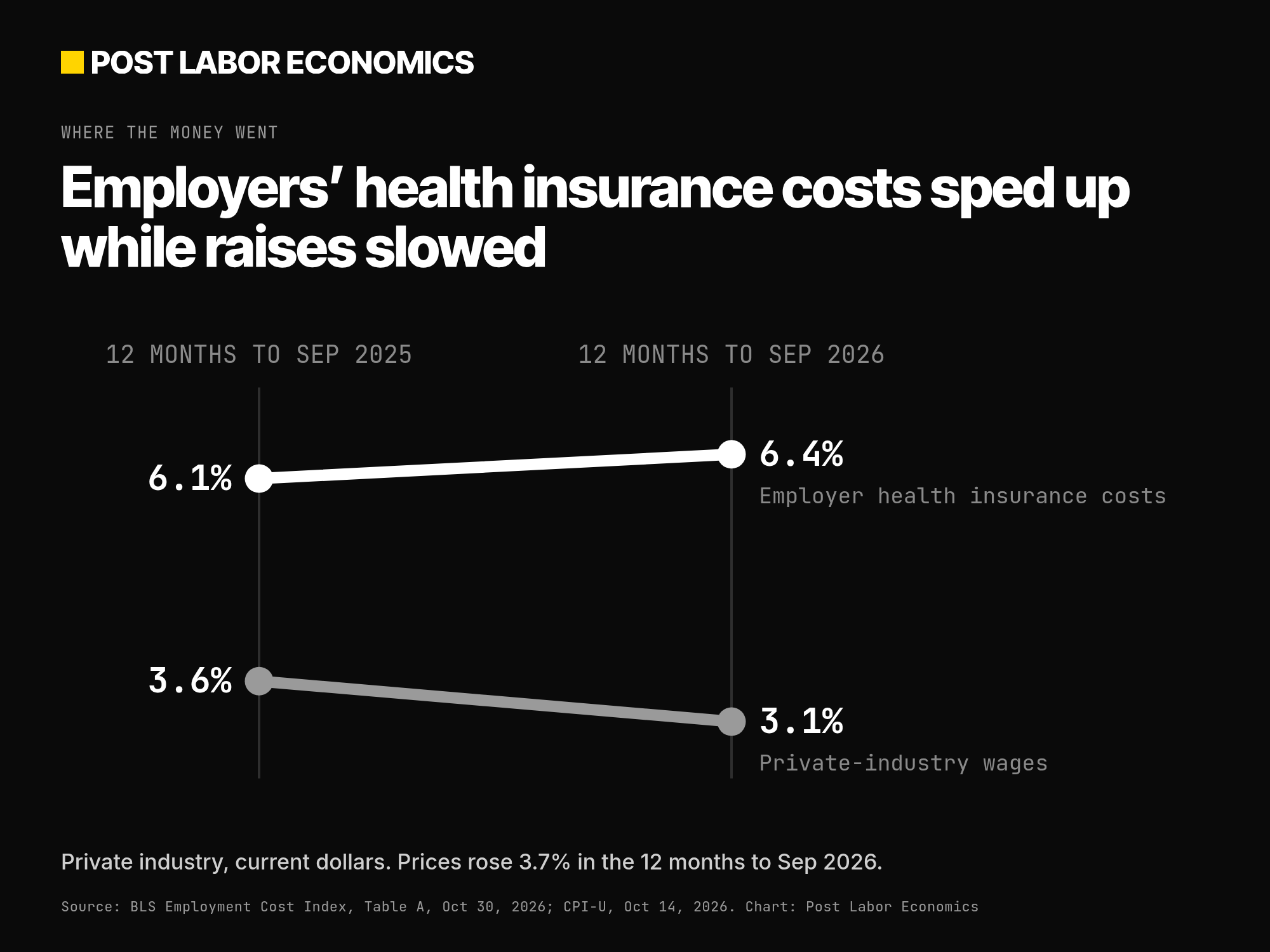
That’s the core of the story. Workers got raises, prices took most of them, and a growing share of what employers spend on labor is going to insurers instead of paychecks.
What Knotts and Rico are facing
Rico said health care was at the center of the walkout. “Healthcare actually is one of the hardest-hit reasons why we’re here today,” he told The Intersection.
Knotts’s problem started with a plan switch. UnitedHealthcare told the state it would raise rates by more than 20%, so the state moved employees to Sutter Health Plan, where the increase was 8%, The Intersection reported.
That works on paper in Sacramento. In Kings County, where Knotts lives, it means losing her doctors.
“I’m 30 miles from the nearest Kaiser,” she said. “That’s not even an option for me.”
Tommy Rico, the union’s Central Valley regional manager, has spent 17 years as a state employee and works in the education department at Corrections. He expects his premiums to rise by $300 a month starting in January.
He’s already deciding what goes. He told the reporter he’s thinking about how to stretch meals, whether to buy new shoes for his kids’ sports, and maybe pulling out old DVDs instead of paying for streaming.
“I’ve thought about it and thought about what we can cut out,” Rico said. “Three-hundred dollars a month is a big hit all at once.”
The raises aren’t coming to cover it. In a summer press release, the union said the state had asked workers to skip raises this year and accept 3% in 2027, according to The Intersection. The union is asking for 20% over three years.
Amber Rich, the union’s communications director, put the two pressures in one sentence. “They’re seeing additional costs in premiums and then also reduced pay.”
The state told The Intersection its representatives were “participating in good faith in mediation with SEIU with the goal of securing a fair and responsible agreement for California’s state workforce.” That sentence would fit any contract dispute in any state in any year.
A mediation session on October 30 ended without a deal, the Sacramento Bee reported. The union’s bargaining page lists the next session as tentatively set for November 20.
Knotts and Rico aren’t typical private-sector workers. They’re unionized public employees, in a state that changed insurers, in a region where the new insurer has fewer doctors. Their premium jumps are far bigger than average.
For comparison, the national KFF survey of employer health plans, released in late October, found the average worker with family coverage now pays $7,471 a year toward the premium. That’s up $621 from 2025.
That works out to about $52 more a month. Rico’s increase is roughly six times that.
But the direction is the same, and so is the public-sector pay picture. The ECI shows state and local government wages up 3.2% over the year, which is down 0.5% after inflation.
A premium increase is a flat dollar amount. A cook and a manager on the same plan pay the same increase, so it takes a much bigger bite out of the smaller paycheck.
That’s part of why Knotts talks about groceries before anything else. When the health deduction grows faster than the raise, the first thing to give is the weekly budget.
Employers are also shifting more of the bill. KFF found that 44% of large firms raised the share of the premium their workers pay this year.
Small employers pass along more still. KFF found workers at small firms pay $9,687 a year for family coverage, which is $2,847 more than workers at large firms pay, according to its release.
Health costs are eating raises before they happen
There are two ways a premium increase hits your pay. One is visible: a bigger deduction on your paycheck, which is what Knotts and Rico are bracing for.
The other is invisible. Your employer spends more on the plan and gives you a smaller raise to make up for it.
The New York Fed asked businesses about this directly in early 2026. Firms whose insurance costs went up gave average raises of 3.8%, and said they would have given about 4.7% if those costs had held steady, according to Liberty Street Economics.
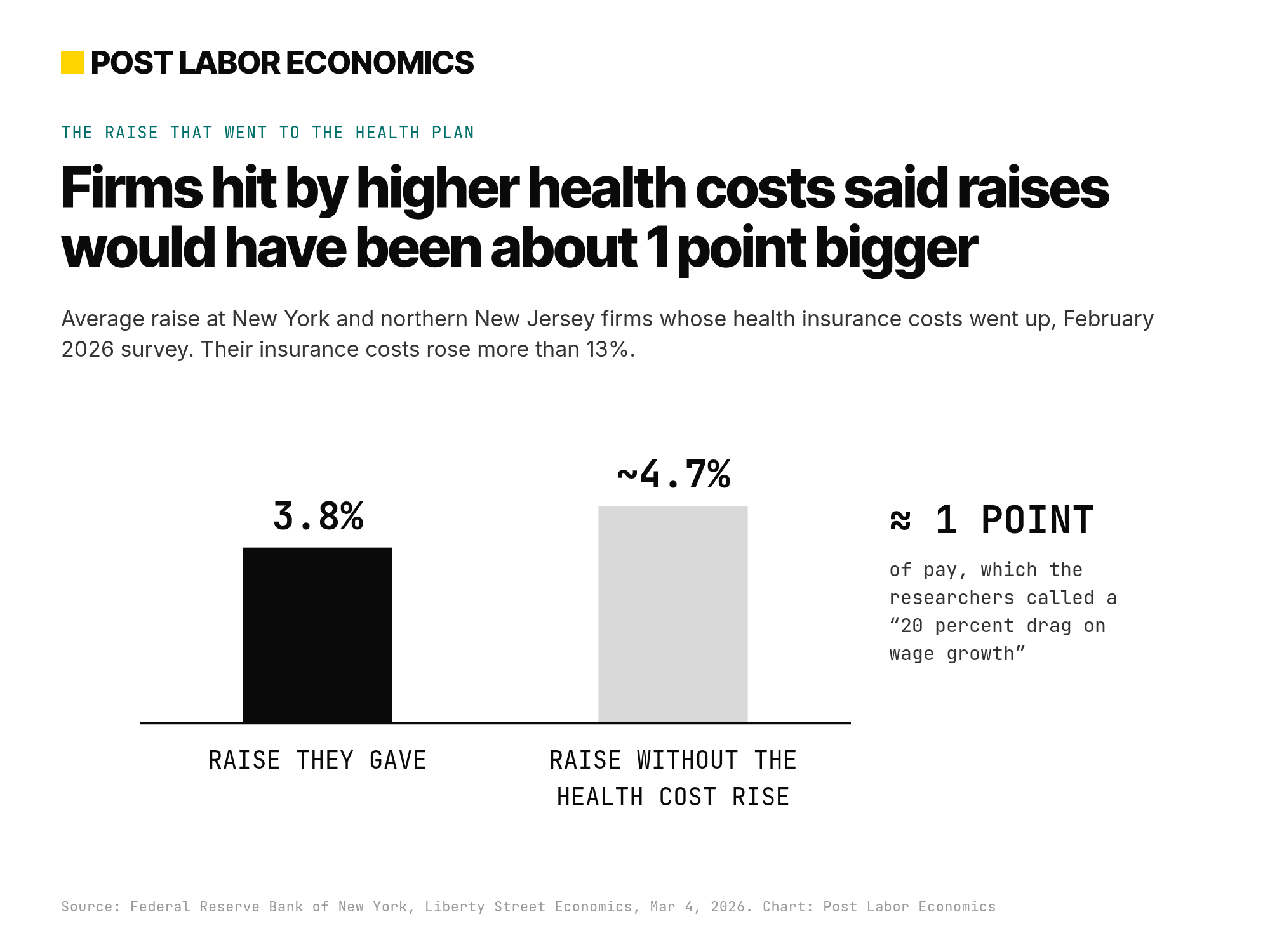
That’s about one percentage point of pay that went to the health plan. The researchers called it “the equivalent of a 20 percent drag on wage growth.”
Smaller raises weren’t the only response. Some firms told the Fed they raised prices or absorbed the cost in their margins, and others raised employee contributions or cut coverage, which lands back on workers’ paychecks.
Those firms told the Fed their insurance costs rose more than 13% as policies renewed. The ECI measure is broader and slower, at 6.4%, but it points the same way.
My read: the raise many workers didn’t get this year is sitting in their employer’s health insurance bill. It never shows up on a pay stub, so nobody argues about it, and that’s exactly why it deserves a line in every wage conversation.
Who still got a real raise
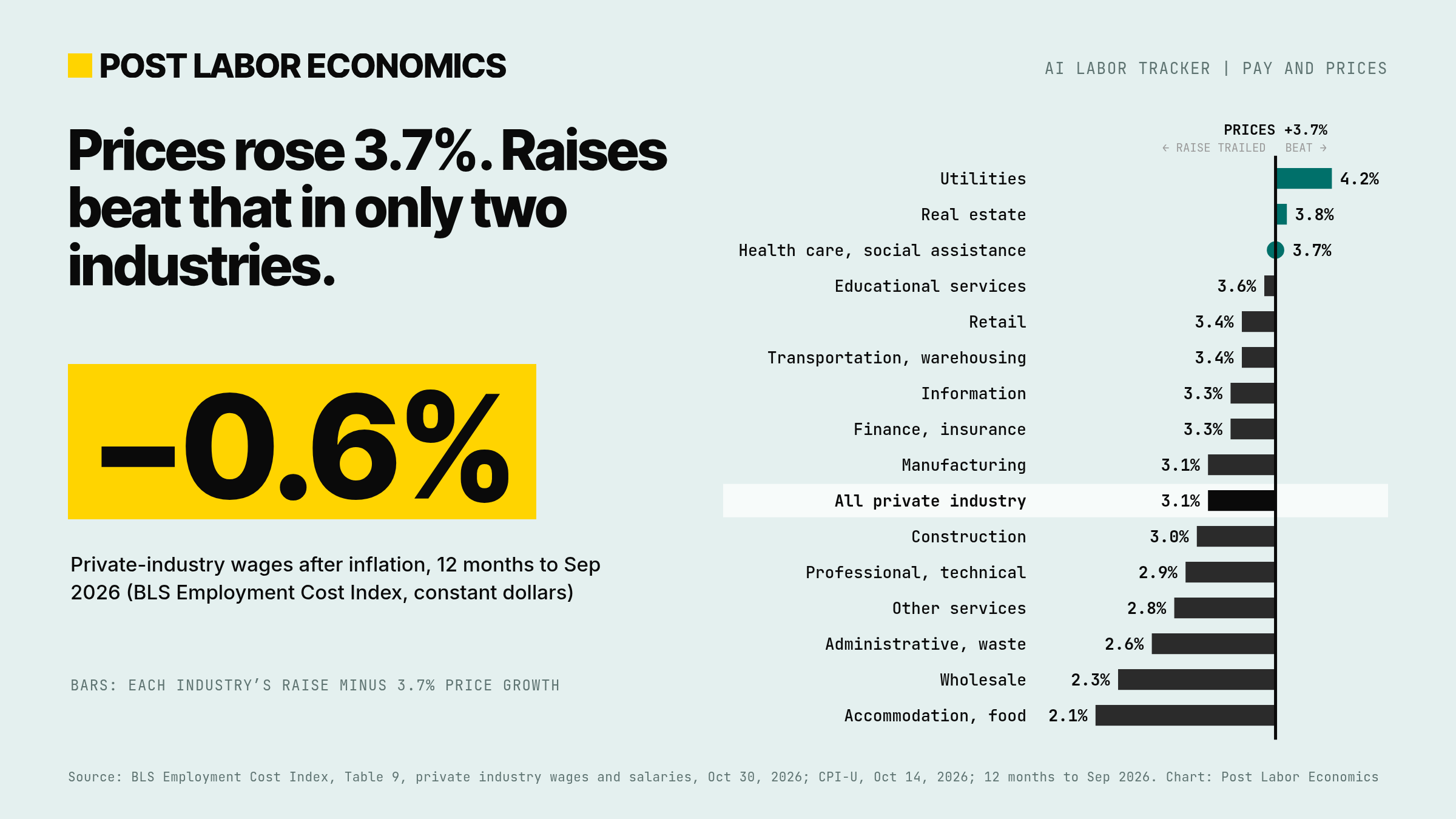
Most groups’ raises trailed inflation, but a few came close or cleared it. The ECI breaks private wages down by industry, and only two major industries topped 3.7%.
Only two industries' raises beat inflation; health care just matched it
Percent change in wages, 12 months to September 2026
3.1% vs 3.7%
Wage growth vs price growth, Sep 2025 to Sep 2026.
Bar chart. Use the up and down arrow keys to move through 17 categories. A data table follows.
Utilities: Wage growth 4.2%
- Utilities (4.2%) and real estate (3.8%) beat prices
- Restaurant and hotel workers got 2.1%, the smallest raise
Figure 1. Private-industry wage growth by industry, 12 months to Sep 2026 (BLS ECI). Gray: CPI (3.7%) and all private (3.1%).
Source: BLS Employment Cost Index, Oct 30, 2026; Consumer Price Index, Oct 14, 2026. Chart: Post Labor Economics Download CSV Methodology
Data table
Not seasonally adjusted. Prices are CPI-U, all items. Industries are BLS major groups; hospitals alone (3.8%) are a subset of health care and social assistance and are not shown separately.
| group | Wage growth |
|---|---|
| Utilities | 4.2% |
| Real estate and rental and leasing | 3.8% |
| Consumer prices (CPI-U) | 3.7% |
| Health care and social assistance | 3.7% |
| Educational services | 3.6% |
| Retail trade | 3.4% |
| Transportation and warehousing | 3.4% |
| Information | 3.3% |
| Finance and insurance | 3.3% |
| All private industry | 3.1% |
| Manufacturing | 3.1% |
| Construction | 3.0% |
| Professional, scientific and technical services | 2.9% |
| Other services | 2.8% |
| Administrative and support and waste services | 2.6% |
| Wholesale trade | 2.3% |
| Accommodation and food services | 2.1% |
Utility workers led at 4.2%, according to the ECI’s industry table. Real estate came in at 3.8%, and hospitals matched it within health care.
At the bottom are the jobs with the lowest pay to begin with. Wages in accommodation and food services rose 2.1%, and in administrative and support services 2.6%.
That’s the same pattern the OECD flagged in July. It found that in the US, low-wage sectors such as accommodation and food and administrative support were the only sectors where real wages fell between early 2025 and early 2026, in its Employment Outlook. With prices rising faster since then, more groups have joined them.
By occupation, the skilled trades held up best. Construction and extraction workers saw wages rise 3.8%, and professional occupations 3.5%.
Sales workers did worst, at 1.8%, partly because commissions follow sales. Service occupations came in at 2.8%.
The industry closest to the AI boom didn’t stand out either way. Wages in the information sector, which includes software publishers and telecom, rose 3.3%, a little above the private average and still short of prices.
Unions mattered too. Union workers’ wages rose 4.3% over the year, compared with 3.0% for nonunion workers, according to the ECI release.
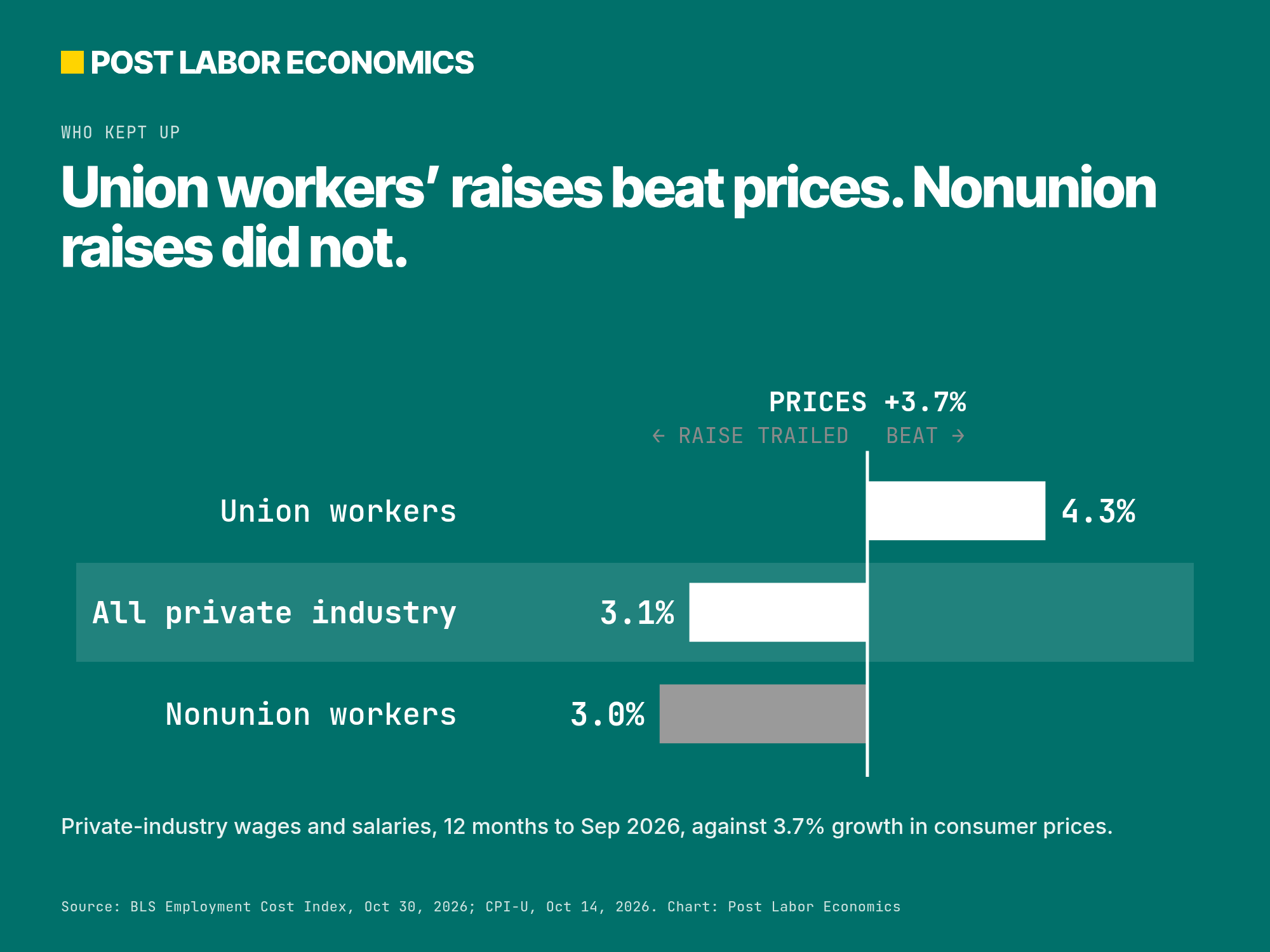
That helps explain why Knotts’s union is fighting so hard over its contract. A union contract has been one of the few things that kept pay ahead of prices this year, and hers lapsed in June.
How the US compares
The cleanest international comparison comes from the OECD, which divides each country’s wage index by its own consumer price index the same way. Its latest country data run through the first quarter of 2026.
Even then, before this year’s energy price jump, American real wages were barely growing. US real hourly wages rose 0.6% from a year earlier, according to the OECD’s data file.
Early in 2026, US real wages grew more slowly than any other economy shown
Percent change in real hourly wages, year on year, Q1 2026
+0.6%
US real hourly wage growth on the OECD measure, Q1 2025 to Q1 2026, the lowest shown.
Bar chart. 12 categories are plotted: Mexico, Korea, OECD average, Spain, Japan, Canada, Italy, Euro area (21), Germany, United Kingdom, France, United States. China and India are not covered. Use the up and down arrow keys to move through 12 categories. A data table follows.
Mexico: Real wage growth 3.9%
- The OECD average was 2.2%, more than three times the US
Figure 2. Real hourly wage growth by country, Q1 2025 to Q1 2026 (OECD). Gray: OECD average.
Source: OECD Employment Outlook 2026, Figure 1.11, Jul 7, 2026. Chart: Post Labor Economics Download CSV Methodology
Data table
Real wages are national wage indices deflated by each country's CPI (OECD Figure 1.11 Panel A). UK and Korea figures are actual wages without compositional adjustment, which the OECD says should be compared with caution; US, Japan and Canada control for compositional effects. Japan covers regular employees at establishments with five or more. China and India are not covered by this series. Data predate the 2026 energy price surge.
| country | Real wage growth |
|---|---|
| Mexico | 3.9% |
| Korea | 2.9% |
| OECD average | 2.2% |
| Spain | 2.0% |
| Japan | 1.7% |
| Canada | 1.5% |
| Italy | 1.3% |
| Euro area (21) | 1.2% |
| Germany | 1.2% |
| United Kingdom | 0.8% |
| France | 0.7% |
| United States | 0.6% |
The OECD average was 2.2%, down from 2.7% a year earlier. France and the UK were close behind the US at the bottom of the big economies.
Japan, where real wages had barely grown a year earlier, reached 1.7%. Germany and the euro area came in at 1.2%.
The longer view is worse for Americans. By the OECD’s count, US real wages in early 2026 were still 1.4% below their level in early 2021, before the post-pandemic inflation spike.
Germany and the UK had climbed back above their 2021 levels by then, the UK by 3.6%. The euro area as a whole was still 1.8% below.
The OECD also warned that these figures predate the energy price surge, and that real wages are expected to weaken from here. The US numbers since then bear that out.
There’s a gap I can’t fill. The OECD series doesn’t cover China or India, and I couldn’t find a quarterly real wage measure for either that’s built the same way. So this comparison covers rich countries and Mexico, and nothing more.
What this means for your next raise
None of this happened because pay stopped rising. Raises of 3% are normal by recent standards.
They just aren’t enough when prices rise 3.7% and the health plan takes its share first. The Bureau of Labor Statistics found real hourly compensation was already slipping in mid-2026, a point I made in What Post-Labor Economics Means, and the newest data show the slide getting worse.
Knotts said what she wants in plain words on the picket line. She hopes the state “comes back to the table and recognizes us and gives us the dignity that we deserve,” and lets workers “have affordable healthcare” and “a living wage.”
That’s a public-sector contract fight, but the demand is the one the national data describe. Pay that keeps up with prices, and a health plan that doesn’t swallow the raise.
Back in Fresno, Knotts and Rico are still waiting. Their contract expired June 30, mediation failed on October 30, and their new premiums start in January whether or not a deal is done.
Rico has already done the math on his kitchen table, and that’s my one recommendation for everyone else. Before you accept a raise or vote on a contract this winter, subtract your new premium share and the inflation rate from it. What’s left is your real raise, and it’s the only number worth negotiating over.
Coming up: third-quarter productivity and real hourly compensation (November 5), the October jobs report with average hourly earnings (November 6), and October CPI (November 10) will update the figures above. The next Employment Cost Index is due January 29, 2027.