
AI Labor Tracker / AI and Customer Service
Half the Call Center Is Gone, and Nobody Got a Layoff Notice
Brinks Home used AI to cut its calls by about two-thirds and halve its call center, mostly by not replacing people who left. Here's who that quiet math hits.
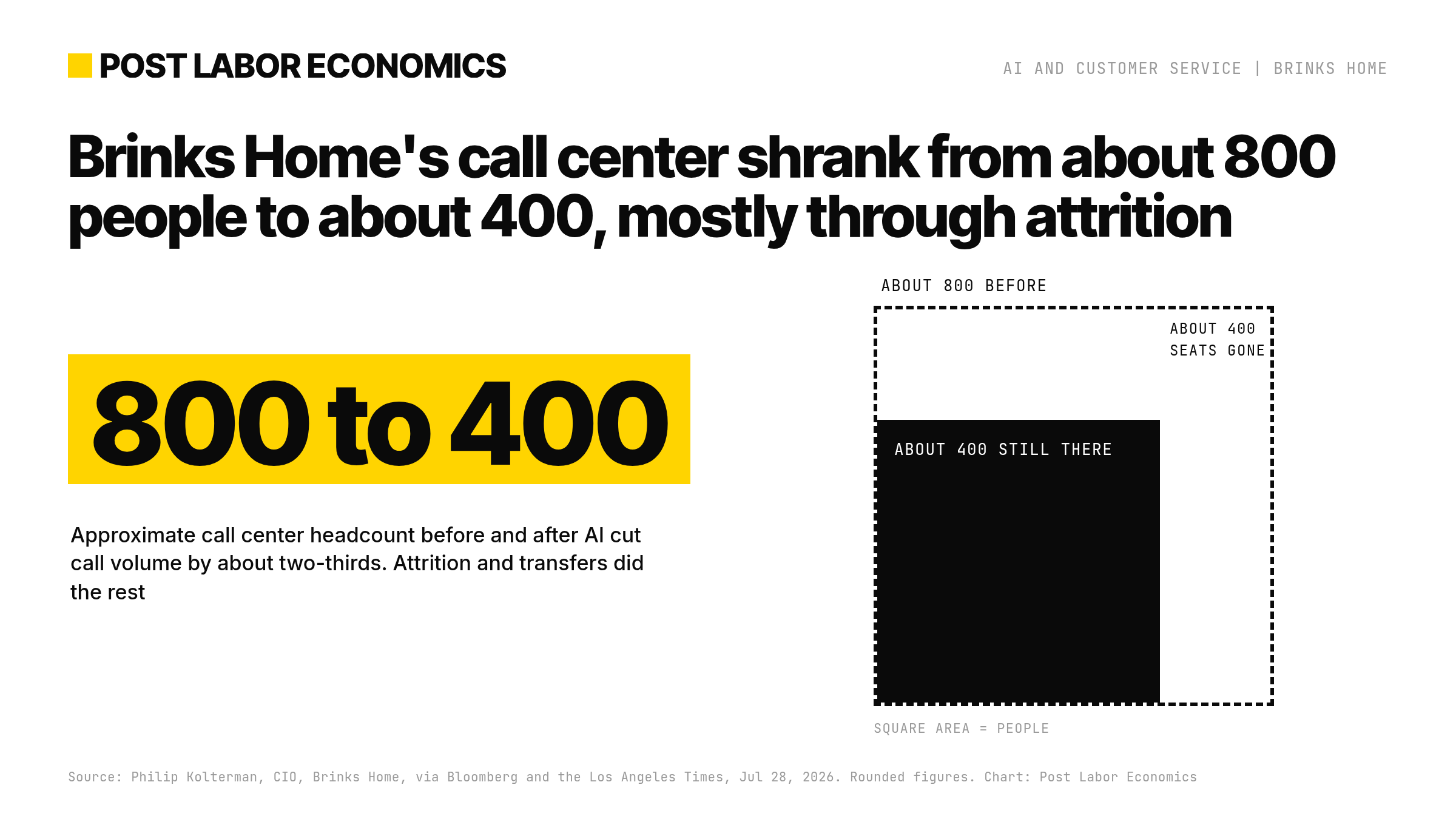
800 to 400
Approximate size of Brinks Home's call center before and after AI cut call volume by about two-thirds (CIO Philip Kolterman, via Bloomberg, Jul 28, 2026)
In March 2025, Philip Kolterman, the chief information officer of Brinks Home, the home-security company, wrote up what his team had learned building an AI agent. The company calls the agent Virty-Vee. He was plain about where it was headed: “Our goal is to enable Virty-Vee to perform all call center functions in our CRM via robust API integration,” he wrote on the blog of Cresta, one of the AI vendors Brinks uses.
A year later, in an interview with the trade site Security Info Watch, Kolterman said most customer contacts now happen through AI-driven digital channels. “As a result, our call volumes have decreased by more than 50% while customer satisfaction scores continue to rise,” he said.
By July the drop in calls had grown to about two-thirds, Kolterman told Bloomberg’s Brody Ford, the Los Angeles Times reported.
The call center shrank to about 400 people from about 800, he said. Some workers moved to other divisions. Natural attrition, he said, took care of most of the rest.
No mass firing and no public notice. Just half as many jobs.
The question nobody files a form for
Here’s what makes this story worth slowing down on.
In the United States, a big layoff at one site usually triggers a WARN notice, a public filing that reporters watch. Attrition triggers nothing. People quit, retire or move, and the company doesn’t post the job again.
So the most common way AI shrinks a workforce may also be the one that leaves the fewest records. Brinks only shows up in the data because its CIO said the numbers out loud.
I’ll start with the upside, because there is one.
Customers who can fix an alarm problem from an app at midnight don’t have to wait on hold. Kolterman says satisfaction went up. And for the reps who stayed, he describes a different job: “agents will spend less time navigating systems and more time guiding outcomes.”
What happens if that’s your job? Specifically, what happens if you’re one of the 400 who aren’t there anymore, or one of the people who would have been hired to replace them?
How typical is Brinks?
Brinks is small. The Bureau of Labor Statistics counted about 2.7 million customer service representatives in the U.S. in 2025, so the Brinks cut is a rounding error on the national total.
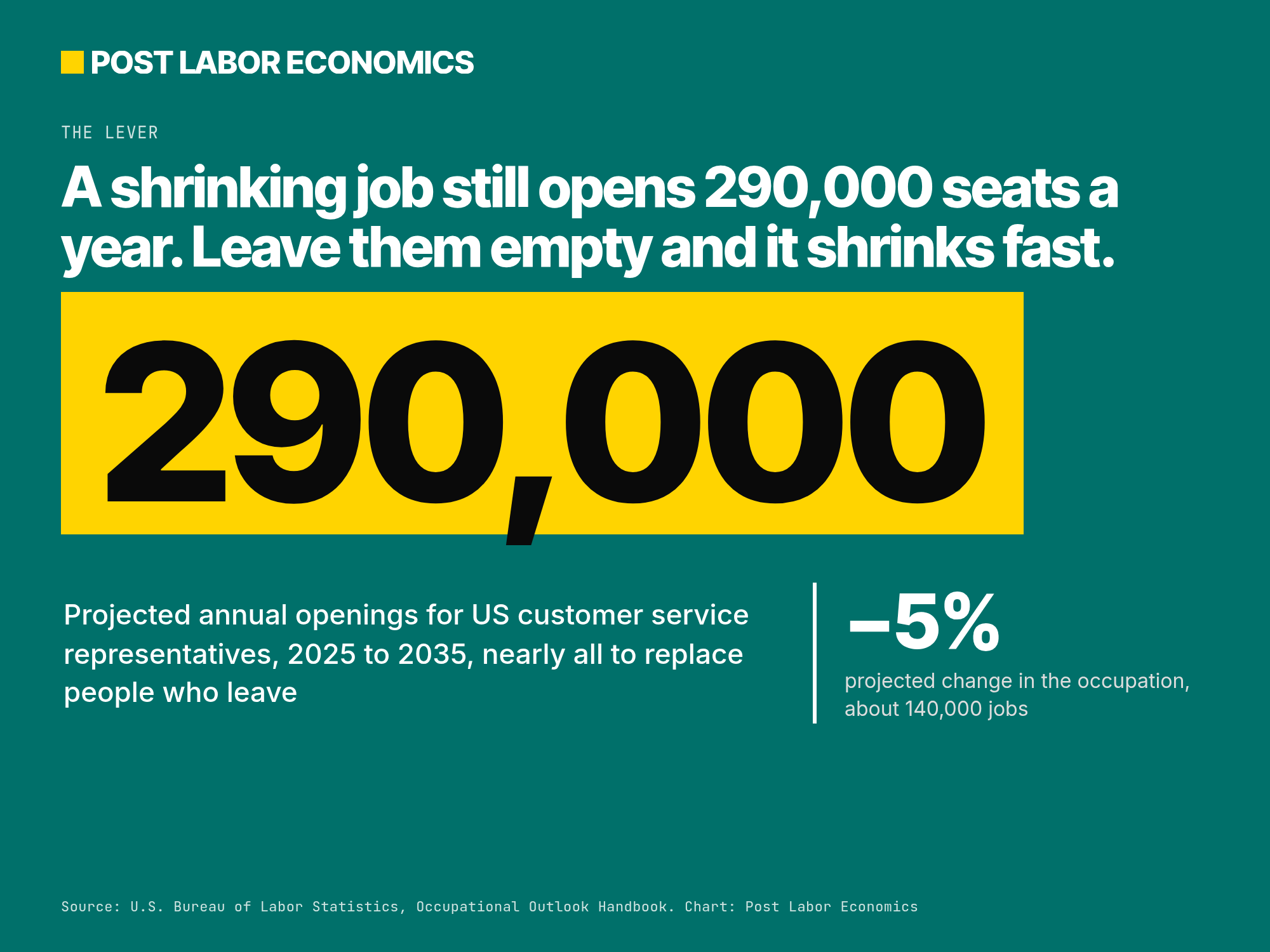
But the direction matches. BLS projects that the occupation will shrink about 5% between 2025 and 2035, a loss of roughly 140,000 jobs. That’s a big decline for one of the largest occupations in the country.
There’s a detail in the BLS numbers that explains the Brinks method.
Even while shrinking, the occupation is expected to have about 290,000 openings a year, nearly all of them to replace workers who leave the job or the labor force, BLS says. That churn is the lever Brinks pulled. When the openings come, you don’t fill all of them.
The Bloomberg piece found the same pattern well beyond one company. Microsoft’s Judson Althoff said in April that AI saves the company about $750 million a year in customer service costs. “If something happened with little Johnny’s Xbox in the middle of the night, we can now solve that with AI,” he told Bloomberg.
Uber cut 10% of its customer service jobs, Bloomberg reported. And Forrester analyst Kate Leggett estimated that almost half of customer service roles will be affected by 2030, while noting that the future job losses are impossible to pin down.
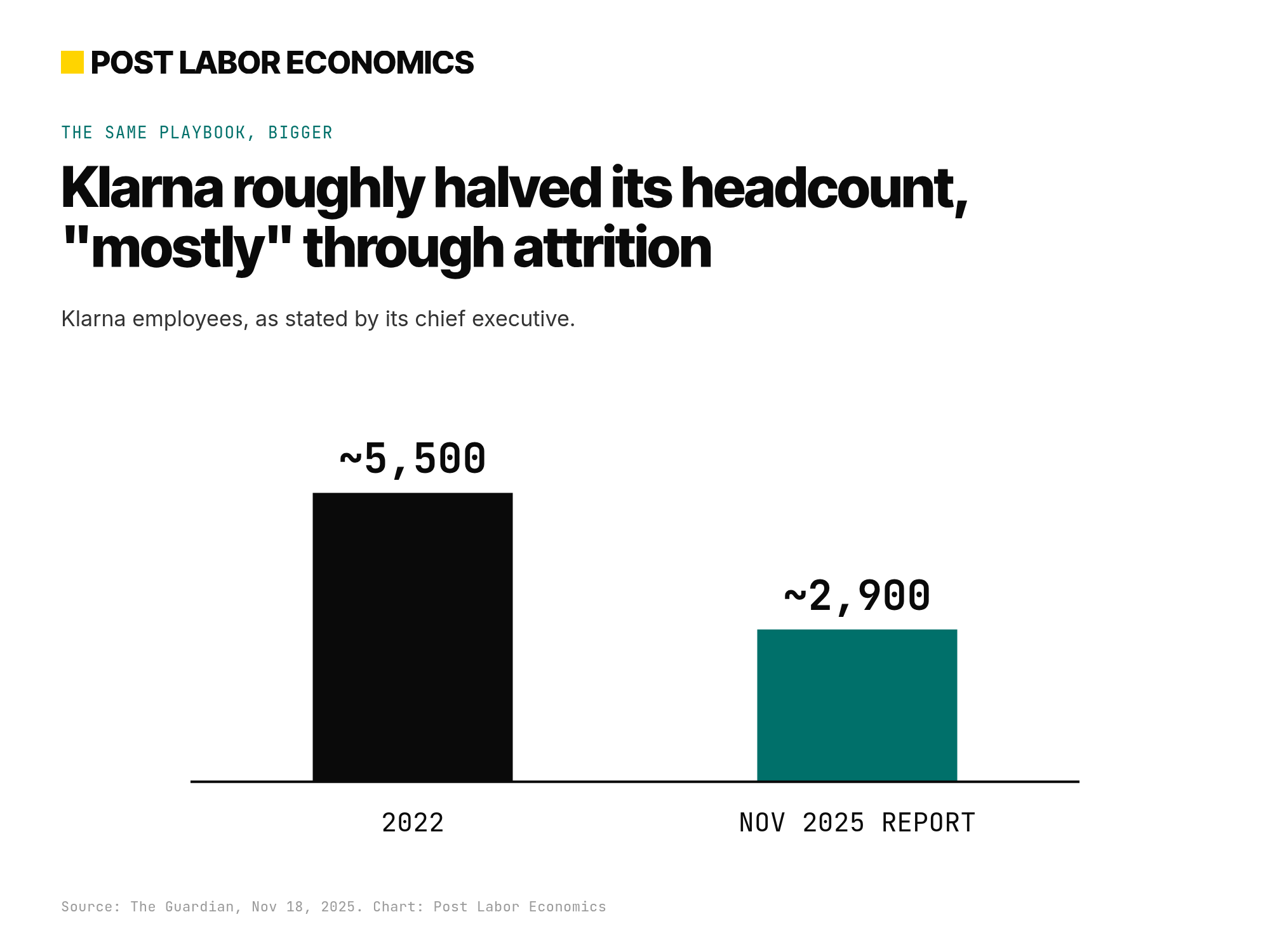
Klarna, the Swedish payments company, ran the attrition playbook at larger scale. Its chief executive said headcount fell from about 5,500 in 2022 to about 2,900, “mostly” through natural attrition, with departing staff replaced by technology, the Guardian reported in November 2025.
At Brinks Home, calls fell faster than the call center shrank
Index, before AI = 100
How to read this100 = before. Bars show what is left.
Derived estimate
−67%
Call volume after AI at Brinks Home; staff fell by half.
Bar chart. Use the up and down arrow keys to move through 2 categories. A data table follows.
Call volume: After 33
- Staff: about 800 to 400
- Each remaining agent takes about 2 calls for every 3 before
Figure 1. Brinks Home call volume and call center staff after AI, before = 100. Company-reported.
Source: Los Angeles Times (Jul 28, 2026), quoting CIO Philip Kolterman. Chart: Post Labor Economics Download CSV Methodology
Data table
"About two-thirds" less call volume: 100 - 67 = 33 left. Staff about 800 to 400: 400 / 800 = 50 left. Calls per remaining agent: 33 / 50 = 0.66, about 2 for every 3. Derived from rounded figures, so label it an estimate.
| measure | Before (=100) | After |
|---|---|---|
| Call volume | 100 | 33 |
| Call center staff | 100 | 50 |
What it feels like from the headset
Brinks hasn’t published anything from the reps themselves, and I couldn’t find a news report that quoted one. So for the view from the inside, I have to borrow from other call centers. That’s a real gap, and it’s worth naming.
In British Columbia, a Telus employee with more than a decade at the company told CBC News in May that agents are expected to use an AI “co-pilot” on all retention calls. When the co-pilot gets something wrong, she said, agents have to submit feedback that’s used to “train” it. She spoke on condition of anonymity for fear of losing her job.
“Will I have a job to feed my family tomorrow?” she said.
Telus told CBC its tools are meant to help agents, aren’t self-training, and that a human handles any feedback. She told CBC she has no proof the co-pilots are being trained to replace agents, but that many co-workers share the suspicion. Michael Phillips, who heads the Steelworkers local that represents about 3,200 Telus workers, put the worry this way: “it seems like a tool that you use on your job until the tool takes over your job.”
That’s the same arc Kolterman described in writing. An assistant first. Then, the stated goal, “all call center functions.”
Who loses the work, and where they live
Here’s the part a U.S. headcount misses. A lot of tier-one support isn’t done in the U.S. at all.
Teleperformance handles some of Brinks’ customer support from a site in Jamaica, Bloomberg reported. Commonwealth Bank of Australia shed hundreds of chat workers, many of them contractors at a center outside Johannesburg run by a South African company, Nutun.
Current and former workers there described anxiety in the ranks as AI took over more of their work, according to Bloomberg.
The outsourcers see it coming. Concentrix, one of the largest, said in its most recent annual report that “some lower complexity services currently performed by our game-changers have been, and may continue to be, replaced by tools deployed by clients.” Concentrix calls its frontline staff “game-changers,” a title that reads differently in a paragraph about replacing them.
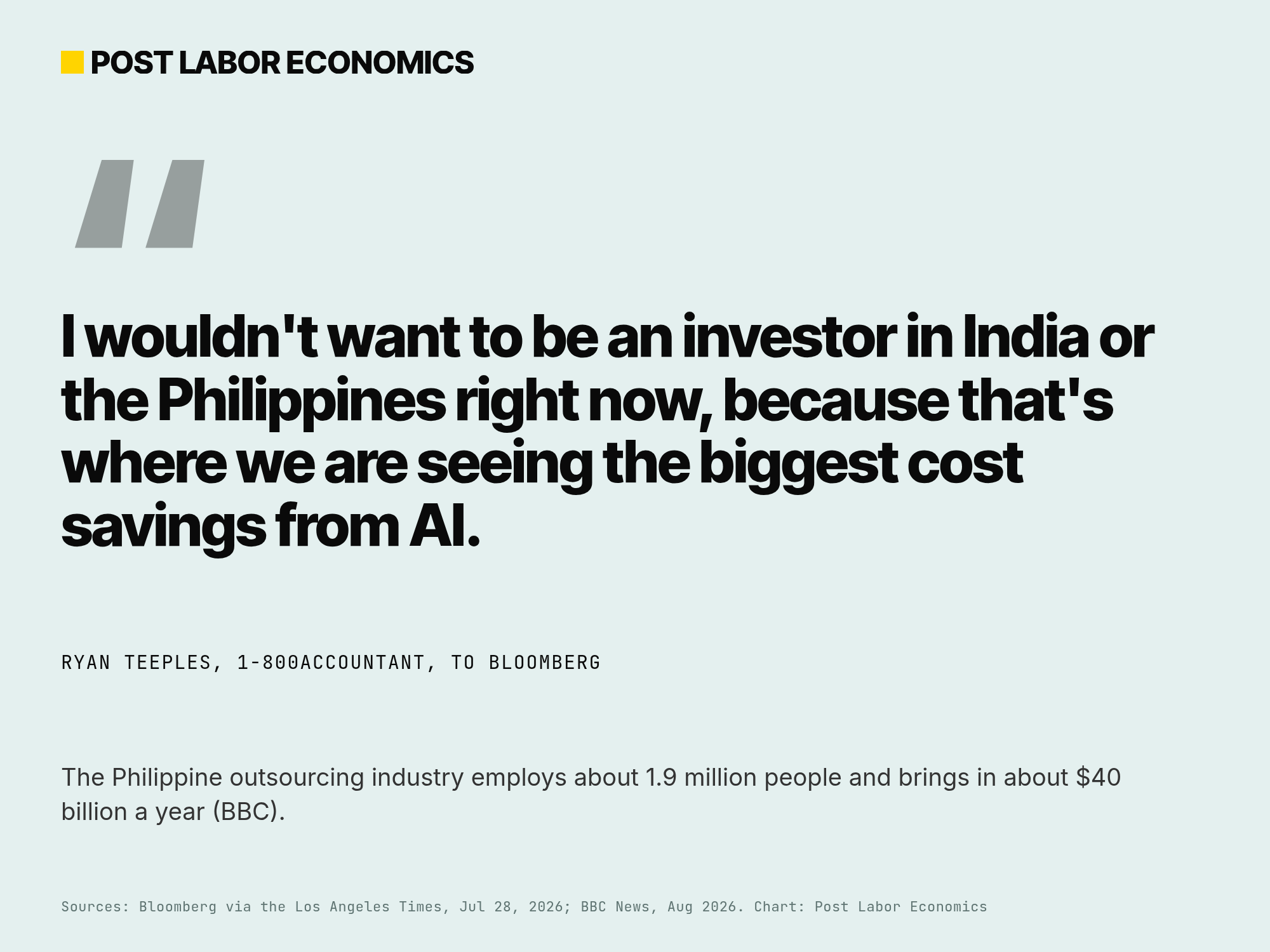
The country with the most at stake is the Philippines. Its outsourcing industry employs about 1.9 million people and brings in about $40 billion a year, the BBC reported in August.
That’s about a tenth of the economy. The International Labour Organization estimates more than one in four Filipino workers are in jobs exposed to generative AI.
Ryan Teeples of 1-800Accountant told Bloomberg: “I wouldn’t want to be an investor in India or the Philippines right now, because that’s where we are seeing the biggest cost savings from AI.” His company expects to spend half as much on outsourced staff next year.
The BBC spoke with former outsourcing workers in Manila, who asked to stay anonymous because they had signed confidentiality agreements for severance. One, a content writer the BBC calls Lisa (not her real name), said she was asked to edit AI-generated material and that her skills were used to train it on the company’s writing style. Then she was made redundant.
“I feel like I dug my own grave,” she told the BBC. “We were the ones who trained the artificial intelligence that replaced us.”
Lisa wrote copy, not phone scripts. But her account matches the Telus agent’s: the worker’s corrections become the system’s training.
The industry hasn’t collapsed. It has lowered its sights.
In July, the industry group IBPAP cut its 2028 targets, the Inquirer reported. The workforce goal fell from 2.5 million to a range that tops out around 2.1 million.
Its outlook for 2026 is still slight growth, to about 1.96 million workers. So this is a story about jobs that won’t be created, which is the Brinks story at national scale.
“I think AI is a real development, but I think we have not really seen it scale yet,” IBPAP president Jack Madrid told the Inquirer. He told the BBC that more than two-thirds of the group’s members are running AI pilots, and that most affected workers have been redeployed.
There’s a fair skeptic’s note here too. Paul Quintos of the University of the Philippines-Diliman told the BBC about “AI washing,” where a company blames AI for cuts that are really about weak demand. He also said there is “tremendous pressure from foreign clients to adopt AI.”
The Philippine outsourcing industry lowered its 2028 hiring goal
Thousands of workers
360,000 to 650,000
Cut from the original 2.5 million target for 2028.
Bar chart. Use the up and down arrow keys to move through 5 categories. A data table follows.
2025 reported: Workers 1,900
- The low end is below the 2025 workforce (1,850,000 vs 1,900,000)
Figure 2. IBPAP's 2025 workforce, 2026 outlook, original 2028 target and revised 2028 range. Industry projections, in thousands.
Sources: Philippine Daily Inquirer (Jul 15, 2026); BBC News (Aug 4, 2026). Chart: Post Labor Economics Download CSV Methodology
Data table
2,500 - 2,140 = 360 thousand; 2,500 - 1,850 = 650 thousand.
| label | Workers |
|---|---|
| 2025 reported | 1,900 |
| 2026 outlook | 1,960 |
| 2028 original target | 2,500 |
| 2028 revised target (low) | 1,850 |
| 2028 revised target (high) | 2,140 |
India is the obvious comparison, and I couldn’t find consistent, current data on its call-center headcount to put next to these numbers. South Africa is the same: we know about the Nutun cut because a reporter found it, not because any public data series shows it. That’s the honest limit of the international picture.
So who gains? The companies first, and they say so.
Kolterman told Security Info Watch that good modernization has to cut operating cost as well as improve service, or “it’s probably not the right investment.”
Customers gain when the app actually fixes the problem. And some workers gain.
Teeples told Bloomberg that 1-800Accountant will use its savings to hire more accountants, mostly in the U.S. At Klarna, average pay per employee rose about 60% over three years as headcount fell, according to the Guardian, though that’s an average across a much smaller staff.
Notice who that list leaves out: the contractor in Johannesburg or Manila or Jamaica whose contract got smaller, and the U.S. worker who would have taken one of those 400 Brinks seats next year.
My read: attrition is the kindest way to shrink a workforce and the hardest one to see. Nobody at Brinks was marched out, and that matters.
But the job that isn’t posted is still a job that doesn’t exist, and those missing jobs fall hardest on people at the bottom of the ladder who needed a first rung.
The limit on that view is real. Brinks’ figures are one executive’s round numbers, the company hasn’t filed anything that shows them, and nobody has published what happened to the workers who moved divisions.
Back at Brinks
Kolterman’s own view of the future is in his March interview. “AI will increasingly sit at the center of the support experience,” he said, diagnosing problems “before an agent becomes involved.” The agents who remain, he said, will focus on “complex situations where human judgment, empathy, and trust matter most.”
That’s the job that’s left: the harder calls. I couldn’t find anything from Brinks on whether it pays more. That July interview is the latest public account of the call center I could find.
Brinks still needs skilled hands, too. Kolterman described technicians diagnosing problems over smartphone video, so a truck doesn’t always have to roll.
On my podcast in 2022, talking with John Flanagan of CareerSource Tampa Bay, I said: “We work a lot with home service companies, and they are dying for more techs. And that’s one of the best jobs. … There are some really amazing jobs out there. You don’t have to go to college for.”
I wrote about one of those trades here.
My recommendation, if you answer phones for a living: ask your manager this month what happened to the last people who left your team. Were their seats refilled, and if someone moved, where did they go? If the answer is that nobody was replaced, you’re watching the Brinks math in your own building, and that’s the time to ask for the cross-training into the complex queue or the field team, while the company still has openings to move you into.