
AI Labor Tracker / AI and Music
Free Songs, Fake Fans: What One Fraud Case Says About AI Music
Half of Deezer's new uploads are now AI-generated, yet they draw a sliver of real listening. The first U.S. AI streaming-fraud case shows why, and who pays.
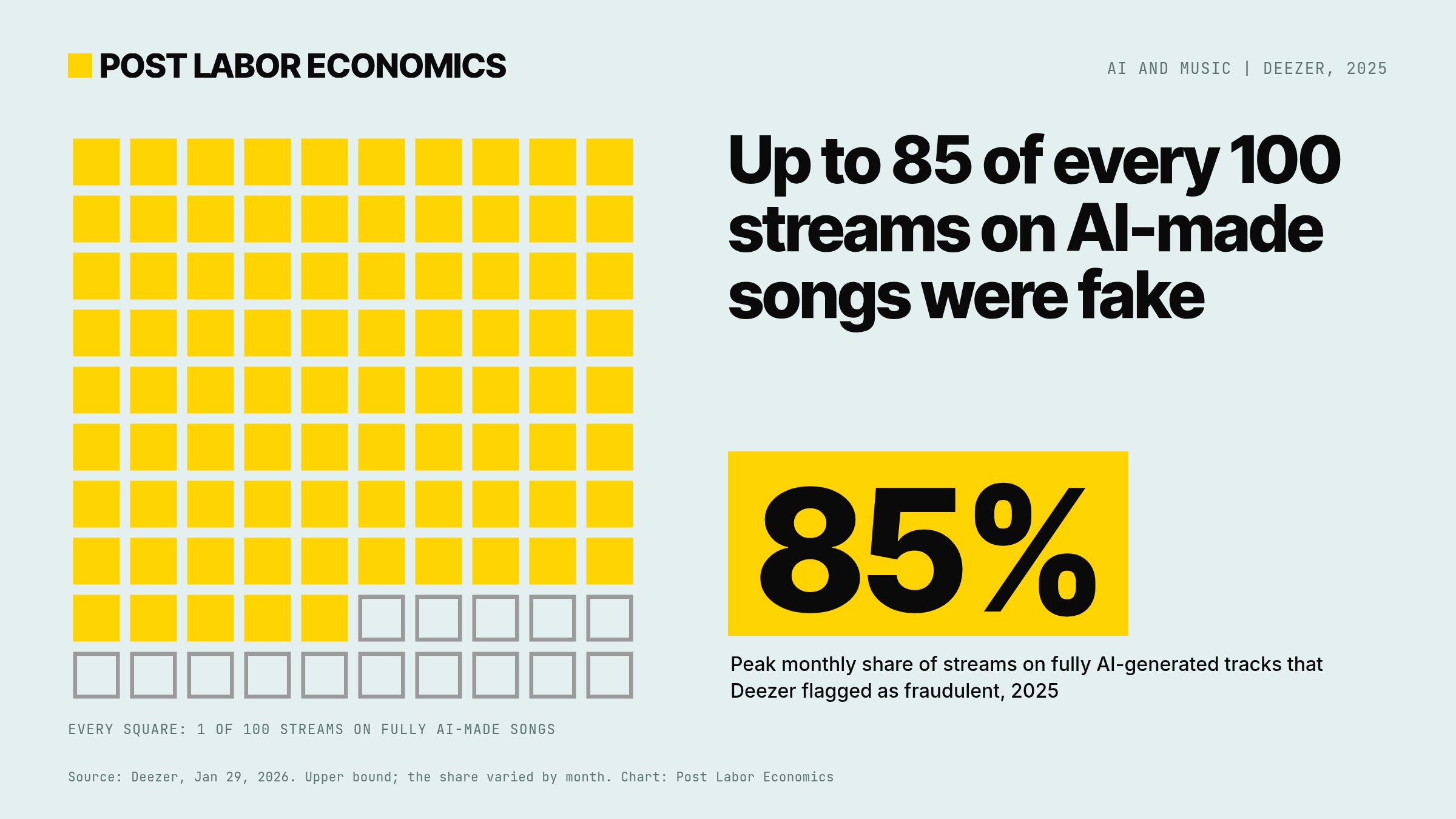
85%
Share of streams on fully AI-generated tracks that Deezer flagged as fraudulent in 2025, at the monthly high (Deezer, Jan 2026)
On December 26, 2018, a North Carolina musician named Michael Smith emailed two co-conspirators with a supply problem. “We need to get a TON of songs fast to make this work around the anti-fraud policies these guys are all using now,” he wrote, according to federal prosecutors.
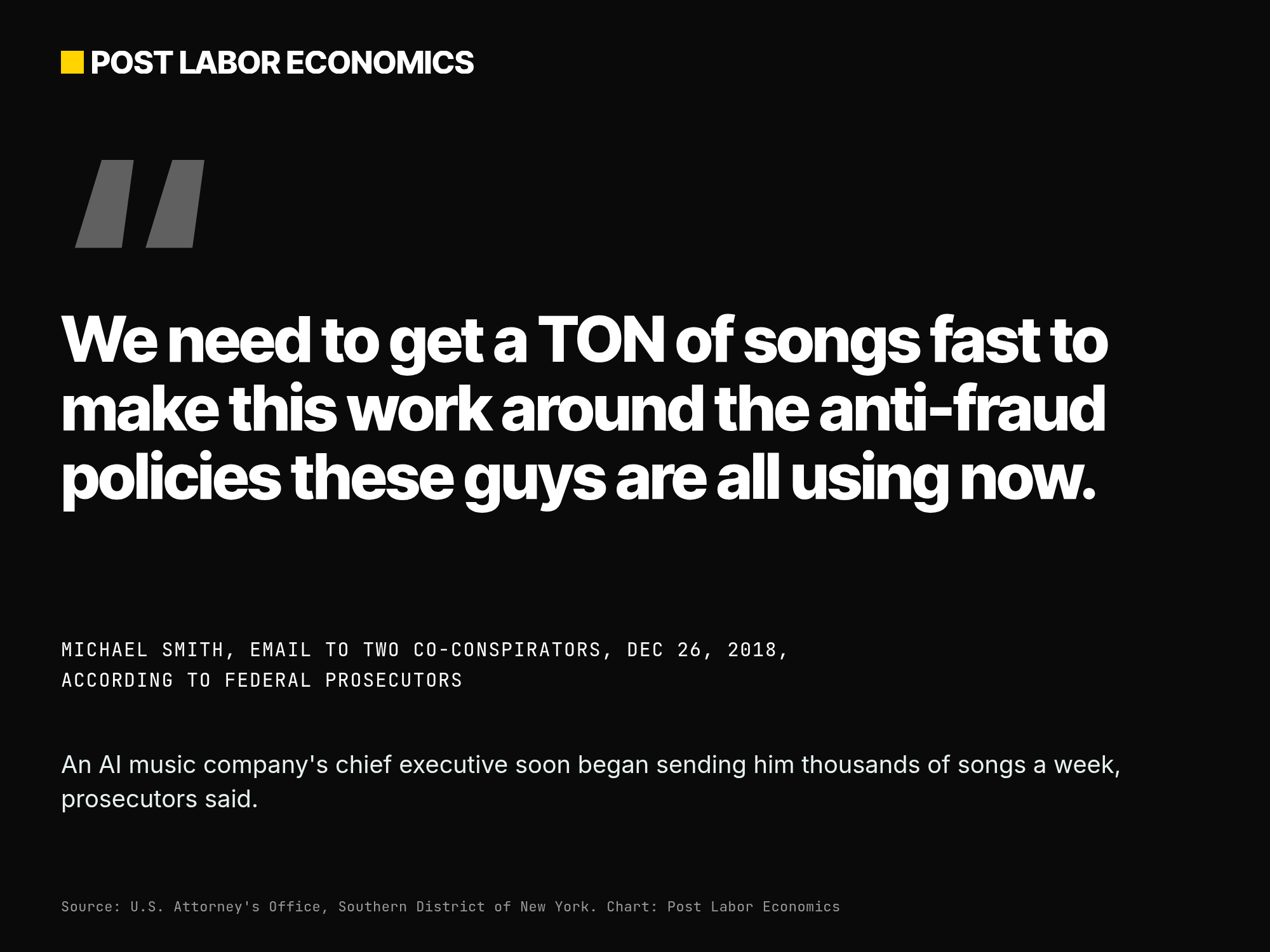
He got them. The chief executive of an AI music company soon began sending him thousands of songs a week, prosecutors said.
The files had names like “n_7a2b2d74-1621-4385-895d-b1e4af78d860.mp3.” Smith gave them titles like “Zygotic Washstands” and credited them to artists like “Calm Knuckles” and “Camel Edible.”
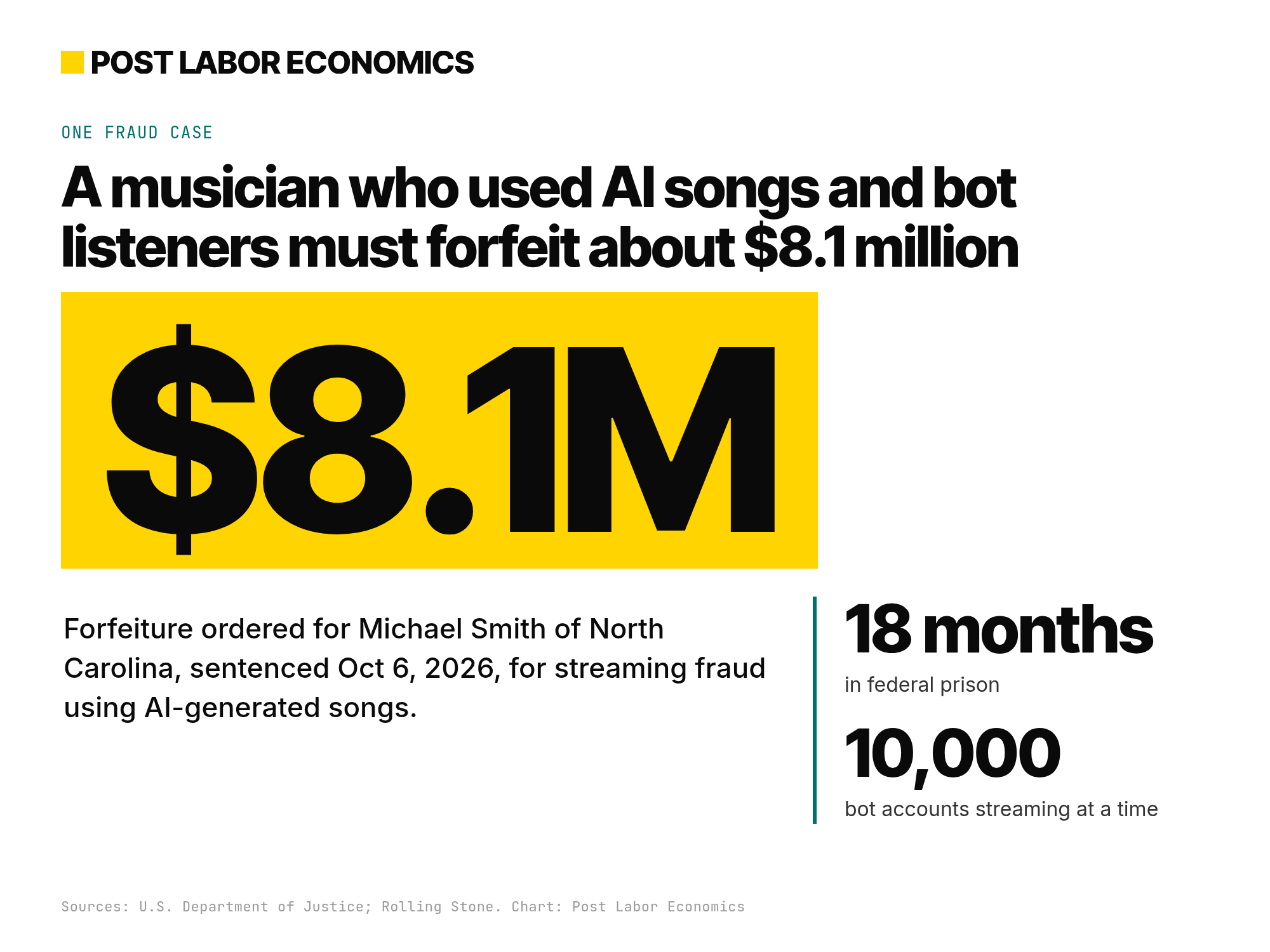
The listeners were bots, as many as 10,000 accounts at a time. On October 6, 2026, Judge John G. Koeltl sentenced Smith, now 54, to 18 months in federal prison.
“I betrayed the music community I care so much about,” Smith told the court, Rolling Stone reported. He said he had turned his love of music into a “perverse business model.”
Smith’s case is a crime story. It’s also the clearest picture I’ve found of what AI has done to music.
The songs were the easy part; a machine made them by the thousand. What Smith couldn’t make was enough people who wanted to hear them, so he faked those too.
That is the AI music economy in one case. Supply has become close to free. Real human attention hasn’t.
So the question for anyone who makes music for a living is plain: when anyone can make a song for almost nothing, who gets paid, and who loses the work?
Half the uploads, a sliver of the listening
The best public numbers I could find come from Deezer, the Paris-based streaming service. It started running an AI detection tool in January 2025, and it has published what the tool finds every few months since. At launch, about one in ten tracks delivered to Deezer each day was fully AI-generated.
That share has gone up every time Deezer has reported it. By June 2026 it passed half of daily uploads on peak days, with a monthly average of about 90,000 fully AI tracks arriving each day, the company said in July.
AI went from a tenth to over half of Deezer's daily uploads on peak days in 17 months
Top, percent of daily uploads. Bottom, fully AI-generated tracks per day.
50%+
AI-generated share of new music uploads to Deezer at its June 2026 peak.
Line chart. Use the left and right arrow keys to move through 7 periods. A data table follows.
2026-06: Upload share 50%, AI tracks 90,000
- 90,000 AI tracks a day: about one a second
Figure 1. AI share of daily uploads to Deezer as published each month. Jun 2026 is a peak-day floor. Fully AI tracks only.
Sources: Deezer newsroom, Jan 2025 to Jul 2026. Chart: Post Labor Economics Download CSV Methodology
Data table
Jan 2025 about 10%; Apr 2025 over 18%; Sep 2025 over 28%; Nov 2025 34%; Jan 2026 about 39%; Apr 2026 about 44%; Jun 2026 over 50% on peak days, 90,000 a day monthly average. Jan 2025 to Jun 2026 = 17 months. 90,000 / 86,400 seconds = 1.04.
| month | Upload share | AI tracks |
|---|---|---|
| 2025-01 | 10% | 10,000 |
| 2025-04 | 18% | 20,000 |
| 2025-09 | 28% | 30,000 |
| 2025-11 | 34% | 50,000 |
| 2026-01 | 39% | 60,000 |
| 2026-04 | 44% | 75,000 |
| 2026-06 | 50% | 90,000 |
Deezer says it detected more than 42 million AI tracks between January 2025 and August 2026, and kept all of them out of its recommendations and editorial playlists.
Now look at who listens. Fully AI tracks account for 1 to 3% of all streams on Deezer. And the company says up to 85% of the streams those tracks got in 2025 were fraudulent, meaning bots and other manipulation, not people.
For comparison, fraud across Deezer’s whole catalog was 8% of all streams in 2025. Deezer’s own summary is blunt: “Generating fake streams continue to be the main purpose for uploading AI-generated music.”
On Deezer, AI music is 44% of uploads and at most 3% of streams
Percent. Each bar has its own denominator.
About 15×
AI tracks were about 44% of uploads but at most 3% of streams (Apr 2026).
Bar chart. Use the up and down arrow keys to move through 4 categories. A data table follows.
AI share of daily new uploads: Percent 44%
- Up to 85% of streams on AI tracks were fraudulent in 2025
Figure 2. AI share of uploads (about 44%) and of streams (1% to 3%, top shown), Apr 2026; fraud shares of streams, 2025. Each bar has its own base.
Sources: Deezer newsroom, Jan 29 and Apr 20, 2026. Chart: Post Labor Economics Download CSV Methodology
Data table
Apr 20, 2026 release: almost 75,000 AI tracks a day, roughly 44% of daily uploads; AI music is 1% to 3% of total streams. 44 / 3 = 14.7, so "about 15×" (floor of the ratio, using the top of the stream range). Fraud: up to 85% of AI-track streams vs 8% of all streams in 2025.
| measure | Percent |
|---|---|
| AI share of daily new uploads | 44% |
| AI share of all streams | 3% |
| Fraudulent share of streams on AI tracks | 85% |
| Fraudulent share of all streams | 8% |
Two cautions before going further. This is one company’s catalog, and Deezer has a stake in the story: since January it has been selling its detection tool to the rest of the industry.
And listening to AI tracks is growing. In September 2025, Deezer put their share of streams at about 0.5%.
Nobody else publishes a matching series, so I can’t tell you what share of Spotify’s or Apple Music’s uploads are AI. Spotify reports a different thing: it removed more than 75 million spammy tracks in the 12 months before September 2025, AI-made or not.
That’s a spam count, and it can’t be laid next to Deezer’s AI count. This year, Spotify says, it has also pulled more than 50 million slop and spam tracks out of recommendations.
Why Smith needed so many songs
Smith’s scheme ran on arithmetic. At one point he estimated his bots could produce about 661,440 streams a day, worth about $1.2 million a year in royalties, prosecutors said.
Spread over hundreds of thousands of tracks, that’s about two plays per song per day, by Music Business Worldwide’s math. That was the design. “In order to not raise any issues with the powers that be we need a TON of content with small amounts of Streams,” he wrote in an October 2018 email quoted by prosecutors.
One song with a billion plays gets noticed. A billion plays spread thin across a mountain of songs doesn’t, at least not for years. AI is what let him build the mountain.
In a 2019 email, the AI company’s chief executive told him: “Keep in mind what we’re doing musically here… this is not ‘music,’ it’s ‘instant music’ ;).”
The scheme ran from 2017 to 2024. In April 2023 alone, Smith’s bots streamed his AI music 80.9 million times through family plans on YouTube Music, prosecutors said in the sentencing announcement. Taylor Swift’s entire catalog got 9.3 million family-plan streams there that month.
That release, for its part, upgrades the technology to “super intelligence.” The same office’s plea announcement in March had called it “artificial intelligence.”
Smith didn’t start as a fraud operation, his lawyers say. In their sentencing memo, they write that he learned guitar at 4, released his first album, Love Interrupted, in 2013, and was the driving force behind One Shot, a hip-hop talent competition that aired on BET in 2016.
His first bot, they wrote, was “simply to gain traction, an attempt to beat the algorithm and eventually generate authentic popularity.”
That’s the defense’s account, and prosecutors argued he knew from the beginning that what he was doing was wrong. But even on his lawyers’ telling, what he was short of was listeners.
How typical is Smith? His scale is rare. He was the first person to face federal charges tied to music streaming fraud in the U.S., according to Rolling Stone and the Justice Department.
Denmark convicted a 54-year-old man of bot-inflating his streams in 2024, and its Western High Court raised his sentence to two years, three months of it to be served, in February 2025, according to the Rights Alliance. That case, the group said, did not involve AI.
“This is a victory for the artists and rights holders who have been deprived of their royalties,” said Thomas Sandberg, chair of the Danish Musicians’ Union.
Smith’s method, though, is what Deezer says most AI uploads are for.
Who loses the work
Here’s the part that makes this a labor story. Streaming services don’t pay a fixed price per play.
“Royalty payments are made proportionately to musicians and songwriters from a pool of funds,” the Justice Department explains. A fake stream doesn’t cost the platform anything extra. It takes a slice from every artist paid out of the same pool.
The Music Fights Fraud Alliance, an industry group, put it this way in a letter to the court: “[e]very fraudulent stream perpetrated by Mr. Smith diluted the value of every legitimate stream occurring during the same accounting period.”
How big a slice? Smith took in more than $14 million from royalty payers, according to the government’s sentencing letter as reported by MBW. The agreed loss was about $8.1 million, after subtracting royalties from legitimate streams of his music and the money he paid into the pools for his bots’ subscriptions.
Spread across the whole industry, that’s small for any one artist. His lawyer Justine Harris argued in court that the damage to others was hard to calculate and likely minuscule, and Spotify told MBW in 2024 that its safeguards had held his take from Spotify to about $60,000.
Prosecutor Nicholas Chiuchiolo answered that even small royalty checks are meaningful, and sometimes the “only recognition” an artist gets for the work, as Rolling Stone reported.
Now scale it up. In a pro-rata pool, if 8% of streams were fake and nobody caught them, every honest stream would be worth roughly 8% less. That’s my arithmetic on Deezer’s catalog-wide figure, and Deezer says it strips the fraud it catches out of royalties.
The real risk is the fraud nobody catches.
France has the most careful outside study I found. The national music center, the CNM, reported in 2023 that between 1% and 3% of streams in France in 2021 were detected as fraudulent, and said the real level is certainly higher than what gets detected.
On Deezer and Spotify, more than 80% of the fraud it found sat below the top 10,000 tracks, in the long tail. That’s where independent musicians live. The French figures predate the AI flood and use different methods, so treat them as a rough floor for that year.
The harm isn’t only money. In July 2025, the Sheffield folk singer Emily Portman got a message from a fan praising her new album. She hadn’t released one.
“It was called Orca, and it was music that was evidently AI-generated, but it had been cleverly trained, I think, on me,” she told the BBC.
No song on Orca passed 2,000 plays on Spotify, so it earned no more than about $6 a track, the BBC estimated.
Spotify took three weeks to take it down, she said. Her real solo album will cost at least £10,000 to make, to pay the people who play on it, produce it, release it and promote it.
“I’ll never be able to sing that perfectly in tune,” Portman said. “And that’s not the point. I don’t want to. I’m human.”
She wasn’t alone. Josh Kaufman, a New York musician and producer who played on Taylor Swift’s Folklore, had a fake track appear on his artist page the same summer. “This is the signature of our soul,” he told the BBC, “and that someone else can walk in there and just have access like that…”
Looking ahead, CISAC, the global federation of authors’ and composers’ societies, commissioned a study from PMP Strategy that projects 24% of music creators’ revenues could be at risk in 2028 under current rules, about €4 billion that year. That’s a projection from an advocate for creators, so read it as one side’s warning.
The pool itself is still growing. Global recorded-music revenue rose 6.4% in 2025, to $31.7 billion, according to IFPI.
Spotify alone says it paid the music industry more than $11 billion last year. A bigger pool is exactly what makes skimming it worth automating.
What AI is good for in music
The upside is real, and it shows up in the same place: real listeners.
Xania Monet is the project of Telisha Jones, a 31-year-old poet who owns a design studio in Olive Branch, Mississippi. She writes the lyrics and used Suno, an AI music generator, plus live elements to make the music, Billboard reported in September 2025. Her manager said 90% of the lyrics are her own true stories.
By mid-September her catalog had 9.8 million on-demand U.S. streams, according to Luminate data cited by Billboard. Bidding to sign her reached $3 million, sources told the magazine, and Hallwood Media signed her to a multimillion-dollar deal.
The same Billboard story has the counterexample. Hallwood had also signed imoliver, the top-streaming creator on Suno, whose single “Stone” had more than 3 million plays inside Suno. After its release on the regular services, it had earned 4,000 on-demand U.S. streams.
Both used the same kind of tool, and only one found a big audience outside it.
That’s the pattern in the data I could find. AI let a poet with something to say turn her lyrics into finished records, and people chose to listen.
On this site we’ve argued that Knowledge is free. Creativity isn’t. Music is the clearest test so far.
The song costs almost nothing now. Somebody choosing it, and coming back, still costs what it always did.
Listeners aren’t against the tools, either. In Deezer’s survey with Ipsos across eight countries, 97% of people couldn’t tell fully AI songs from a human one in a blind test of three tracks.
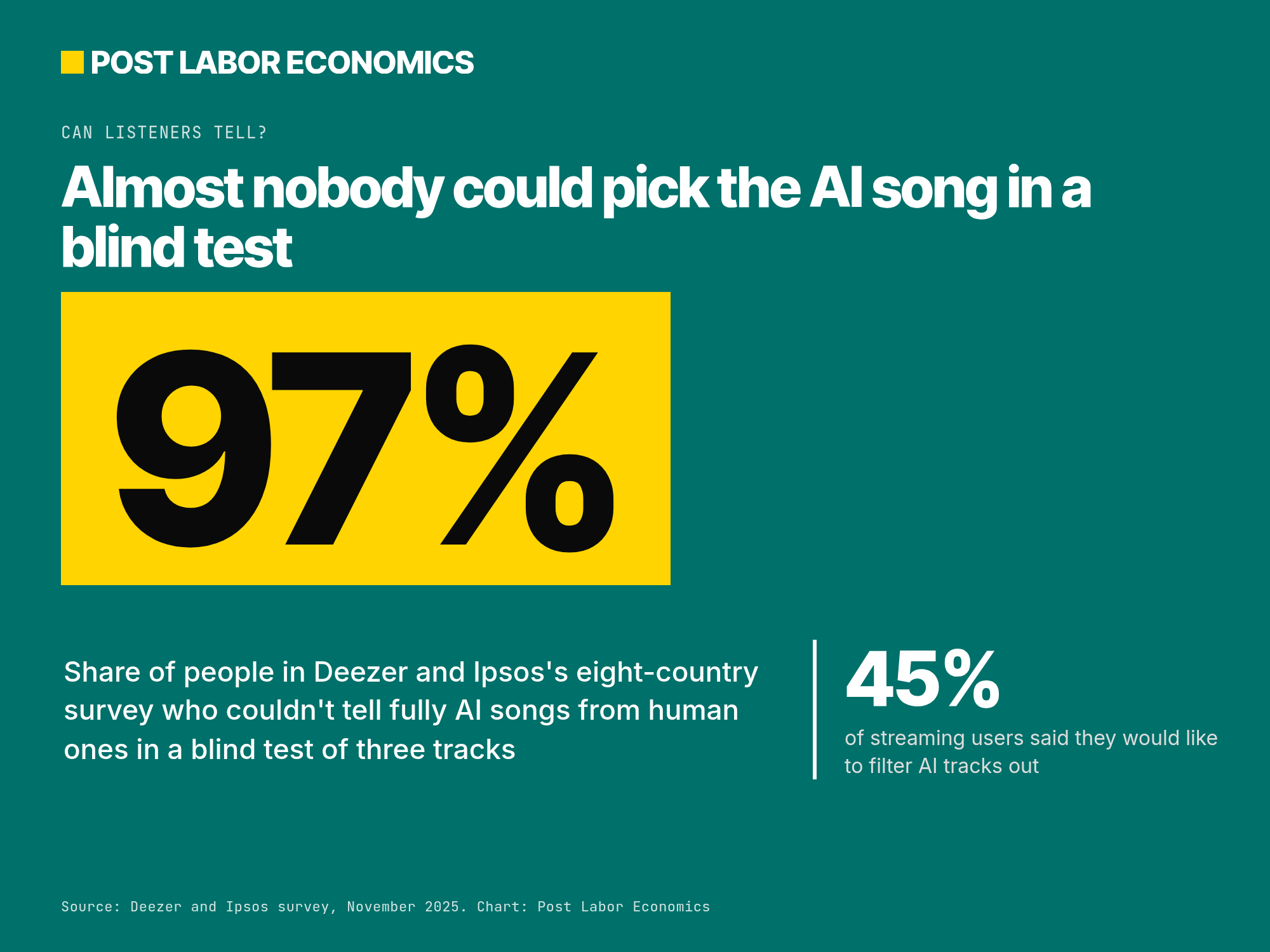
Two-thirds of streaming users said they’d try an AI track out of curiosity, though 45% said they’d like to filter them out.
The industry is cutting deals. Universal Music settled with Udio in October 2025 and agreed to build a licensed creation and streaming service with it. Warner settled with Suno a month later, with new licensed models due and an opt-in for artists whose voices and likenesses users could work with.
Spotify says artists now submit tens of thousands of AI credits a day, showing which parts of a song were made with AI.
Who’s writing the rules
The rules differ a lot by country, and no two countries measure the same thing, so this section compares approaches only.
The European Union. The AI Act’s transparency article has applied since August 2, 2026, according to the European Commission. Companies that make generative tools must mark synthetic audio in a machine-readable way; older systems have until December 2.
A visible label for listeners is required for deepfakes, meaning content that resembles real people or things and would falsely appear authentic. As I read the Commission’s guidance, a fully synthetic song by an invented artist like “Calm Knuckles” doesn’t clearly meet that test, so the listener-facing label may never reach most AI tracks.
Denmark. Beyond its streaming-fraud conviction, Denmark’s culture minister introduced a bill on October 8 that would require consent to share realistic digital imitations of a person’s appearance or voice, with separate protection for performers. It had its first reading on October 22 and went to committee, parliament’s record shows. It has not passed.
The United Kingdom. In March 2026 the government dropped its preferred plan to let AI firms train on copyrighted work unless rights holders opted out, Music Week reported. It now says it has no preferred option, and music groups expect work on labeling and digital replicas next.
The United States. The main tool so far is the fraud statute that convicted Smith. The NO FAKES Act, which would create a federal right over AI replicas of a person’s voice and likeness, cleared the Senate Judiciary Committee in June. Senator Ted Cruz blocked an attempt to pass it by unanimous consent on September 30, Forbes reported.
Where the data is missing: I found no country that publishes the AI share of its streams, and no major platform besides Deezer that publishes the AI share of its uploads. Until they do, nobody can say whether Europe’s or America’s approach is working better.
My read: the supply fight in AI music is over, and supply won. Nothing will stop the uploads.
The fight that matters for working musicians is over the count: whether a stream on the meter came from a person who chose a song.
Labels and filters help listeners choose. Fraud detection protects the pool.
Of the two, the second does more for the people whose income depends on it, because manufactured attention takes money from everyone in the pool, while an AI song that real people pick competes fairly.
The honest limit is that almost all the data here comes from one company that sells detection, and from one court case. I’d change my mind if another big platform published numbers showing AI tracks drawing real listening at scale.
Back to Smith
Smith is due to serve 18 months in prison and forfeit about $8.1 million, according to the Justice Department. His lawyer argued in court that prison wouldn’t deter streaming fraud, and that only structural reform of the streaming system would.
He got the songs he asked for in 2018, hundreds of thousands of them. What he couldn’t get, at least not in the numbers he needed, was people. Nobody who downloads a music generator gets those for free either.
Before he was sentenced he told the judge, “I have made a mess of what was an honorable life.”
Deezer said in July it would start taking down AI tracks used for fraud and those nobody has streamed in six months. Before the end of this year, it says, users everywhere will get a switch that hides fully AI tracks, albums and artists from search.
My recommendation: treat your streams as the scarce thing they are. Pick artists on purpose instead of leaving autoplay running, and when your service offers an AI label or filter, use it so that choice is yours. On a shared royalty pool, a real listener choosing a song is the only vote a working musician gets.
Sources
- U.S. Attorney’s Office, SDNY. “North Carolina Musician Charged With Music Streaming Fraud Aided By Artificial Intelligence.” Sep 4, 2024. https://www.justice.gov/usao-sdny/pr/north-carolina-musician-charged-music-streaming-fraud-aided-artificial-intelligence
- U.S. Attorney’s Office, SDNY. “North Carolina Man Pleads Guilty To Music Streaming Fraud Aided By Artificial Intelligence.” Mar 19, 2026. https://www.justice.gov/usao-sdny/pr/north-carolina-man-pleads-guilty-music-streaming-fraud-aided-artificial-intelligence-0
- U.S. Attorney’s Office, SDNY. “North Carolina Man Sentenced To 18 Months In Prison For Super Intelligence-Assisted Music Streaming Fraud.” Oct 6, 2026. https://www.justice.gov/usao-sdny/pr/north-carolina-man-sentenced-18-months-prison-super-intelligence-assisted-music
- Jon Blistein. “Music Streaming Fraudster Sentenced to 18 Months in Prison.” Rolling Stone, Oct 6, 2026. https://www.rollingstone.com/music/music-news/mike-smith-sentence-18-months-music-streaming-fraud-1235636944/
- Mandy Dalugdug. “Man behind $8m AI song and bot streaming fraud is sentenced to 18 months in prison.” Music Business Worldwide, Oct 7, 2026. https://www.musicbusinessworldwide.com/man-behind-8m-ai-song-and-bot-streaming-fraud-is-sentenced-to-18-months-in-prison/
- Defendant’s sentencing memorandum, United States v. Smith, No. 1:24-cr-00504-JGK (S.D.N.Y.), Doc. 57, filed Sep 22, 2026 (via CourtListener). https://storage.courtlistener.com/recap/gov.uscourts.nysd.627522/gov.uscourts.nysd.627522.57.0.pdf
- Deezer. “Deezer deploys cutting-edge AI detection tool for music streaming.” Jan 24, 2025. https://newsroom-deezer.com/2025/01/deezer-deploys-cutting-edge-ai-detection-tool-for-music-streaming/
- Deezer. “Deezer reveals 18% of all new music uploaded to streaming is fully AI-generated.” Apr 16, 2025. https://newsroom-deezer.com/2025/04/deezer-reveals-18-of-all-new-music-uploaded-to-streaming-is-fully-ai-generated/
- Deezer. “Deezer: 28% of all music delivered to streaming is now fully AI-generated.” Sep 11, 2025. https://newsroom-deezer.com/2025/09/28-fully-ai-generated-music/
- Deezer. “Deezer and Ipsos study: AI fools 97% of listeners.” Nov 12, 2025. https://newsroom-deezer.com/2025/11/deezer-ipsos-survey-ai-music/
- Deezer. “Deezer confirms demonetization of up to 85% of AI-music streams due to fraud and moves to sell AI-detection Technology.” Jan 29, 2026. https://newsroom-deezer.com/2026/01/deezer-confirms-demonetization-of-ai-music/
- Deezer. “Deezer: AI-generated tracks now represent 44% of all new uploaded music.” Apr 20, 2026. https://newsroom-deezer.com/2026/04/ai-generated-tracks-represent-44-of-new-uploaded-music/
- Deezer. “Deezer: AI music has surpassed 50% of new music uploads for the first time.” Jul 21, 2026. https://newsroom-deezer.com/2026/07/ai-music-exceeds-50-percent-daily-uploads-deezer/
- Deezer. “Deezer will let you fully exclude AI-generated music from your streaming experience.” Oct 13, 2026. https://newsroom-deezer.com/2026/10/deezer-ai-music-toggle/
- TechCrunch. “Music streamer Deezer says more than 50% of daily uploads are AI-generated.” Jul 21, 2026. https://techcrunch.com/2026/07/21/music-streamer-deezer-says-more-than-50-of-daily-uploads-are-ai-generated/
- Spotify. “Spotify Strengthens AI Protections for Artists, Songwriters, and Producers.” Sep 25, 2025 (with later update). https://newsroom.spotify.com/2025-09-25/spotify-strengthens-ai-protections/
- Spotify. “One Year In: Putting Human Artistry First on Spotify.” Oct 20, 2026. https://newsroom.spotify.com/2026-10-20/prioritizing-human-artistry/
- Spotify. “From $11B in 2025 Payouts to What We’re Building for Artists in 2026.” Jan 28, 2026. https://newsroom.spotify.com/2026-01-28/2025-music-industry-payouts-whats-next-for-artists/
- IFPI. “Global Music Report 2026: Global recorded music revenues grow 6.4%.” Mar 2026. https://www.ifpi.org/global-music-report-2026-global-recorded-music-revenues-grow-6-4-as-record-companies-drive-innovation/
- CISAC and PMP Strategy. “Study on the economic impact of AI in music and audiovisual industries.” https://www.cisac.org/services/reports-and-research/cisacpmp-strategy-ai-study
- Centre national de la musique (CNM). “Fake streams, real phenomenon” (press release on its study of stream manipulation in France). Jan 16, 2023. https://cnm.fr/wp-content/uploads/2023/01/CP_CNM_Manipulation-des-streams_ENG.pdf
- Rights Alliance (Rettighedsalliancen). “High Court Increases Sentence in Streaming Fraud Case.” Feb 5, 2025. https://rettighedsalliancen.com/high-court-increases-sentence-in-streaming-fraud-case-two-years-in-prison-and-confiscation-of-3-5-million-dkk/
- Ian Youngs and Paul Glynn. “Fans loved her new album. The thing was, she hadn’t released one.” BBC News, Aug 22, 2025. https://www.bbc.com/news/articles/clydz8d03dvo
- Billboard. “AI Artist Xania Monet Climbs the Charts, And Signs a Multimillion-Dollar Record Deal.” Sep 16, 2025. https://www.billboard.com/pro/ai-music-artist-xania-monet-multimillion-dollar-record-deal/
- Universal Music Group. “Universal Music Group and Udio announce Udio’s first strategic agreements for new licensed AI music creation platform.” Oct 29, 2025. https://www.universalmusic.com/universal-music-group-and-udio-announce-udios-first-strategic-agreements-for-new-licensed-ai-music-creation-platform/
- The Guardian. “Warner Music signs deal with AI song generator Suno after settling lawsuit.” Nov 26, 2025. https://www.theguardian.com/business/2025/nov/26/warner-music-signs-deal-with-ai-song-generator-suno-after-settling-lawsuit
- European Commission. “Transparency obligations under Article 50 of the AI Act” (FAQ). Jul 24, 2026. https://digital-strategy.ec.europa.eu/en/faqs/transparency-obligations-under-article-50-ai-act
- EuGFA. “Denmark proposes consent rule for AI imitations of faces and voices.” Oct 20, 2026. https://eugfa.org/briefing/denmark-deepfake-consent-bill
- Folketingstidende. “L 49 (2026-27): Forslag til lov om ændring af lov om ophavsret.” https://www.folketingstidende.dk/samling/20261/lovforslag/L49/index.htm
- Andre Paine. “Music trade bodies welcome government’s decision to ditch text & data mining exception for AI firms.” Music Week, Mar 18, 2026. https://www.musicweek.com/digital/read/music-trade-bodies-welcome-government-s-decision-to-ditch-text-data-mining-exception-for-ai-firms/093790
- Rick Ellis. “Ted Cruz Stops Senate Effort To Pass AI Deepfake Bill.” Forbes, Sep 30, 2026. https://www.forbes.com/sites/rickellis/2026/09/30/ted-cruz-stops-senate-effort-to-pass-ai-deepfake-bill/