
AI Labor Tracker
Why Ford Paid About 350 Veteran Engineers to Check Its Work and Its AI
Ford brought back hundreds of veteran engineers and jumped to the top of a quality ranking. The headlines said AI failed. Ford's own engineer tells a more useful story.
350
Veteran engineers Ford says it hired over three years to review designs and train AI tools (Ford via Bloomberg and Fortune, Jun 2026)
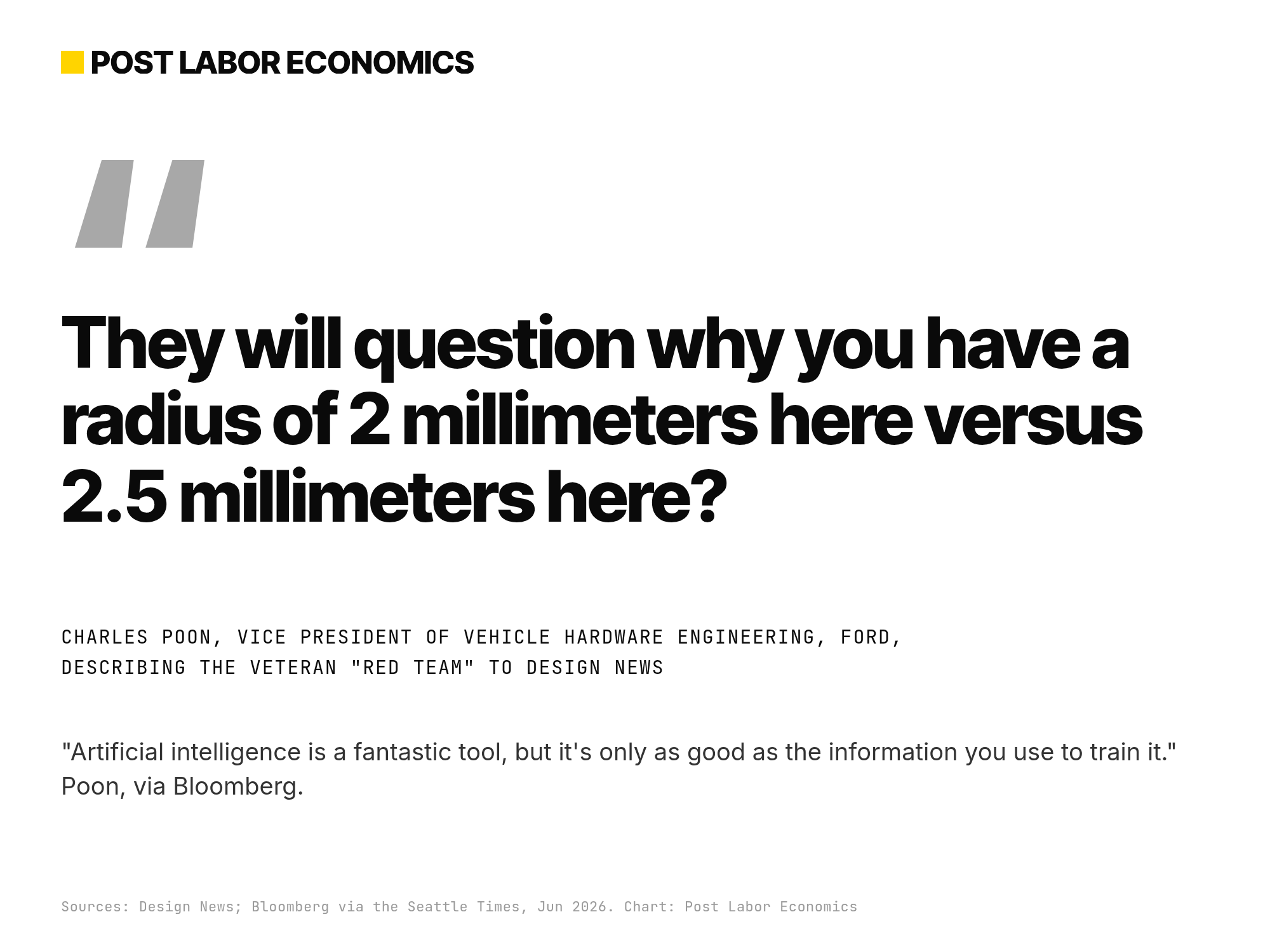
On Wednesday, June 24, 2026, Ford’s vice president of vehicle hardware engineering, Charles Poon, got on a call with reporters and said something car companies rarely say out loud. “Artificial intelligence is a fantastic tool, but it’s only as good as the information you use to train it,” he said, according to Bloomberg.
Then he admitted a mistake. “Over prior years, we didn’t pay as much attention as we should have to the experience of our most knowledgeable engineers that have been with us through many product cycles.”
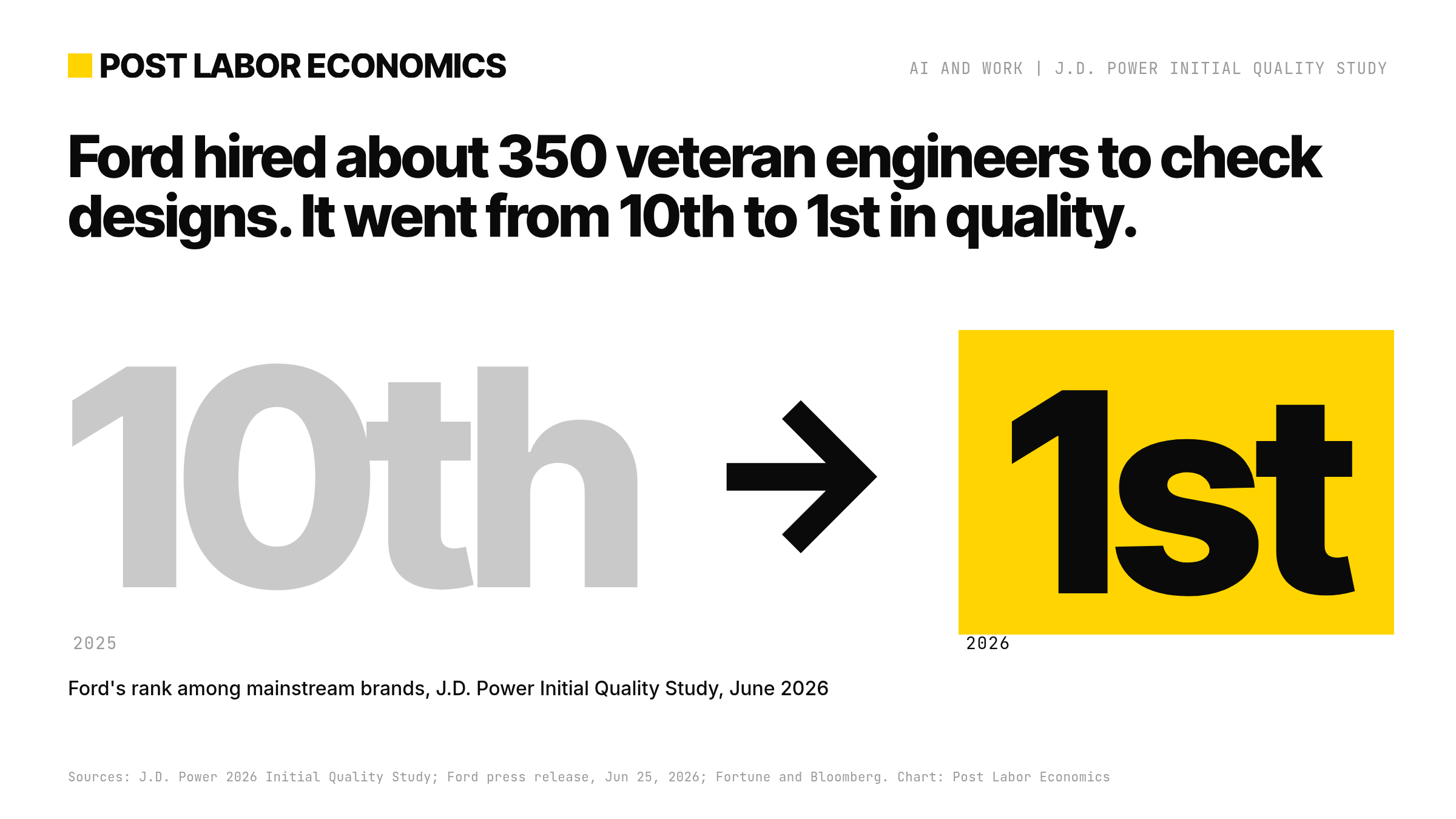
Ford’s fix was people. Over three years, it hired about 350 veteran engineers, many of them former Ford employees and others from suppliers. Inside the company they are called “gray beards,” Fortune reported.
The next day, J.D. Power’s Initial Quality Study put Ford at the top of the mainstream brands. A year earlier, Ford had ranked 10th.
Within days the story went around the world as “AI fell short, so Ford rehired humans.” TechCrunch, the BBC and the Guardian all ran versions of it.
It’s a satisfying story. I’m not sure it’s the right one.
If you are an experienced engineer, technician or specialist, you have probably been told that AI will make your knowledge cheap. Ford seems to say the opposite: that the knowledge is what makes the AI work.
So the question is simple. Is Ford proof that companies cut experienced people too fast for AI and are now paying them to come back? Or is it something narrower, and more useful, for the people who do this work?
What Ford actually said
Start with Ford’s own words, because they are more careful than the headlines.
In its June 25 press release, Ford said “reaching best-in-class quality required a significant talent refresh.” It replaced about two-thirds of its senior industrial-system leaders. And it said it “hired roughly 300 veteran engineers who carry the hard-earned wisdom of decades of design.”
“Free from daily production schedules, these engineers now act as internal auditors,” the release says. A spokesperson later told Fortune the company had “hired more than 350 experienced tech specialists to work alongside newer team members.”
So the count is roughly 300 in the release and 350 in what Ford told Fortune and Bloomberg. I use “about 350” because that’s the figure Ford gave reporters most often, but treat it as approximate.
The release also has a small problem with its own baseline. Its opening puts Ford at No. 15 in the 2023 study, and its FAQ puts it at No. 16. For a document about catching defects before they ship, that’s a fitting place to find one.
Here is the part the “AI backfired” version left out. A month later, Poon sat down with Dan Carney of Design News, an engineering trade publication.
Carney wrote that while it had been “widely reported that Ford is backpedaling on an overreliance on artificial intelligence tools, in fact, the quality concerns predated Ford’s AI use, and the company has used AI tools as part of the quality turnaround, Poon said.”
Poon traced the problem to “inconsistent discipline in problem solving” and to people leaving. “There was an impact of an outflow of experience probably three or four years ago,” he said.
That doesn’t erase what he told reporters in June. On that call, Poon also said, “Mistakenly, we thought that by just introducing artificial intelligence and ingesting the design requirements that we had, that that would produce a high-quality product.”
Put the two together and the story is clearer. Ford lost experienced people, quality slipped, and AI trained on thin knowledge didn’t rescue it. The veterans came back to do the reviewing and to teach the tools.
What the veteran engineers do all day
Poon described the job to Design News in some detail. “Think of them as like a red team, okay?” he said.
“The red team is individuals who look at the engineers’ designs. They work with them in a way to find where the weak points are.”
“Their sole mission is to help the younger engineers analyze their designs,” he said. They go through material choices and dimensions with the engineer.
“They will question why you have a radius of 2 millimeters here versus 2.5 millimeters here? How did you go about choosing it?”
On a fuel system, Ford puts five or six specialists on a red team, Poon said. Some of them had retired before coming back.
They check the machines too. Ford hired them partly to “reprogram ineffective artificial intelligence tools,” Fortune reported, and the specialists now “reprogram AI tools to counter glitches before they occur.”
That’s a mentoring job with authority attached. These specialists hold senior positions, Carney reported, so their reviews can change a design.
The AI is still there, and it’s doing a lot. Ford runs an AI vision system on off-the-shelf smartphones across 33 plants, with more than 1,000 cameras doing millions of inspections, the company told Fortune. It checks things like hose and electrical connections before a part moves down the line.
On transmissions, Poon said, test machines collect “hundreds of thousands of traces” a day. Machine learning flags the slight anomalies, the engineers pull the part, and sometimes they find “a piece of contamination that shouldn’t have been there.”
“The idea is that there are many tools like that that augment the engineers,” Poon said. “They don’t necessarily replace them.”
My read: Ford didn’t swap AI for people. It found that both work better with veterans setting the standard, and it was willing to pay for that.
How big is 350?
The “Ford rehired humans” story makes it sound like a hiring wave. Here’s the comparison that matters: Ford’s headcount in its annual reports to the SEC.
Ford employed about 186,000 people at the end of 2020. At the end of 2025 it was about 169,000, according to its latest 10-K.
Ford's workforce fell 9% from 2020 to 2025; Ford says it hired about 350 veteran engineers since 2023
Thousands of employees at year end
−9%
Change in Ford's total employees, year-end 2020 to 2025, per its 10‑K filings.
Line chart. Use the left and right arrow keys to move through 6 periods. A data table follows.
2025: Total 169, United States 87
Figure 1. Year-end employees, from Item 1 of Ford's 10‑K filings. US excludes Ford Credit; Total includes it.
Source: Ford Motor Company, Form 10‑K for 2021, 2023 and 2025, SEC EDGAR. Chart: Post Labor Economics Download CSV Methodology
Data table
US figures start in 2022, the first year these filings break them out on this basis. The 2020 figure was restated in the 2021 filing. About 350 veteran engineers were hired from 2023 on, per Ford's statements to reporters.
| year_end | Total | United States |
|---|---|---|
| 2020 | 186 | not published |
| 2021 | 183 | not published |
| 2022 | 173 | 84 |
| 2023 | 177 | 87 |
| 2024 | 171 | 87 |
| 2025 | 169 | 87 |
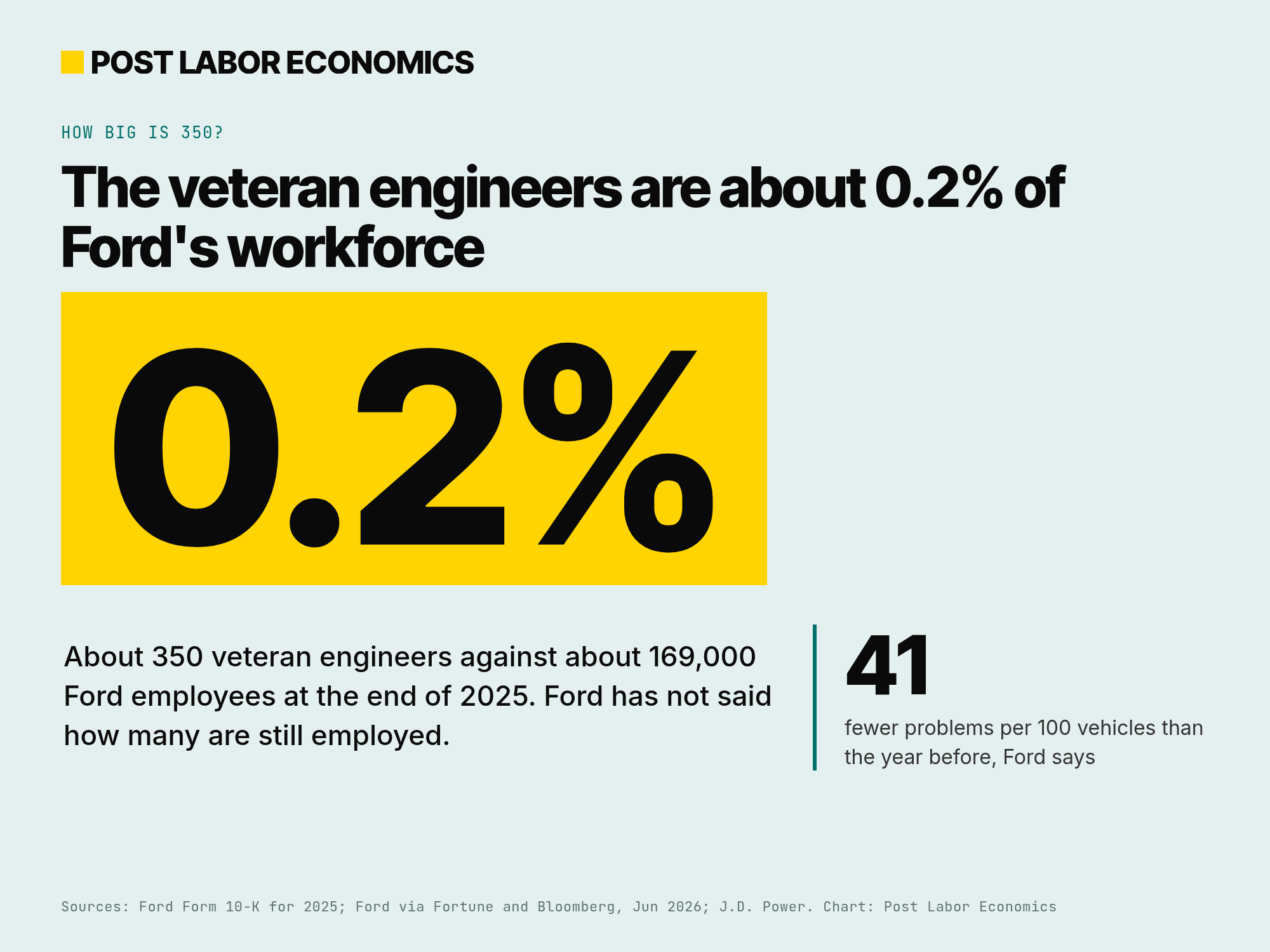
Against that, the veteran engineers are about 0.2% of the workforce. My arithmetic, and the honest limit is that Ford hasn’t said how many of the 350 are still employed, or how many people left over the same years.
That’s why I’d read Ford as a story about which experience matters, not how many jobs AI made. The company’s U.S. headcount was flat at about 87,000 from 2023 to 2025. Globally it kept shrinking.
The payoff, so far, is in the quality numbers. Ford says it had 41 fewer problems per 100 vehicles than the year before, and seven of its ten tested models ranked in the top three of their segments.
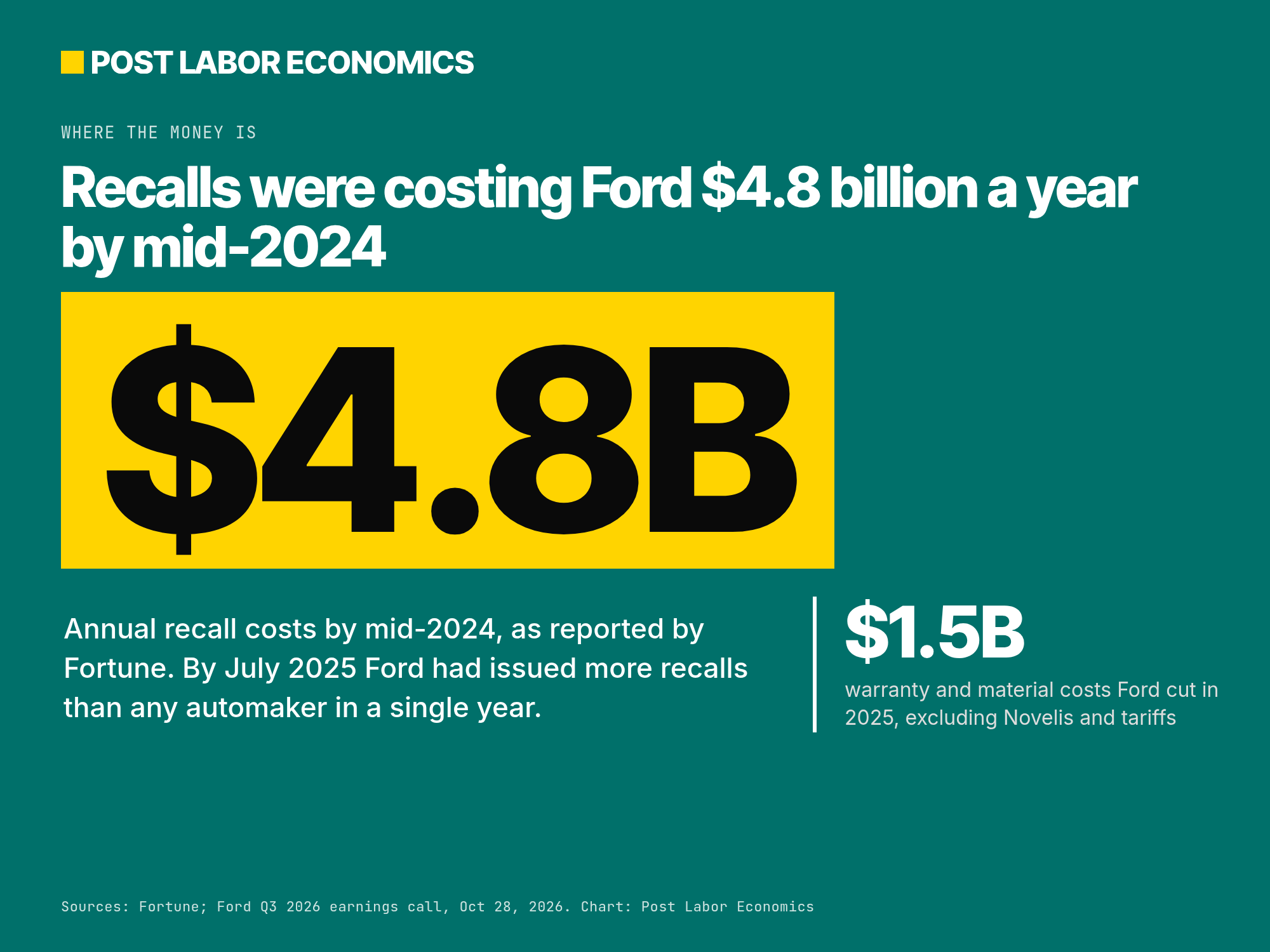
The money is in warranty. Recalls were costing Ford $4.8 billion a year by mid-2024, Fortune reported. By July 2025, it had issued more recalls than any automaker ever had in a single year.
“We’re seeing our warranty coverages come down. We’re seeing our recall costs come down,” CEO Jim Farley said in June. “These are all contributing to literally hundreds and hundreds of millions of dollars of a tail wind for Ford on cost.”
Ford isn’t the only company to reverse course
Ford never fired the veteran engineers for AI. Other employers did cut people for AI and then backed off.
The best documented case is in Australia. In July 2025, Commonwealth Bank cut 45 customer service roles as it introduced an AI “voice-bot.” In August it reversed the decision and apologised for the “error,” ABC News reported.
The bank said it “did not adequately consider all relevant business considerations.” The Finance Sector Union, which had taken the dispute to the Fair Work Commission, said call volumes rose after the bot arrived, “with management scrambling to offer overtime and even pulling team leaders onto the phones.”
“CBA has been caught out trying to dress up job cuts as innovation,” the union’s national secretary, Julia Angrisano, said. The affected staff could stay, be redeployed or leave.
That case is more than a year old, and it’s small. The surveys are bigger, but softer.
More than half of leaders who cut staff for AI say they made the wrong call
Percent. Each bar has its own base.
55%
Share of leaders who cut staff for AI and say it was the wrong call, Orgvue, 2025.
Bar chart. Use the up and down arrow keys to move through 3 categories. A data table follows.
Leaders who made employees redundant as a result of deploying AI: Share 39%
Figure 2. Three surveys with different bases and dates; don't add them. Bars 1 and 2: Orgvue, 2025. Bar 3: Robert Half, 2026.
Sources: Orgvue, 2025; Robert Half, via CNBC, Jul 1, 2026, and Fast Company, Jun 5, 2026. Chart: Post Labor Economics Download CSV Methodology
Data table
Bar 1 is the share of 1,163 senior leaders in eight countries who made employees redundant as a result of deploying AI (Orgvue, fieldwork Feb to Mar 2025). Bar 2 is the share of those leaders who admit they made wrong decisions about the redundancies. Bar 3 is the share of US hiring managers who eliminated a role primarily because of AI and later rehired for the same or a similar position (Robert Half). The survey covered 2,000 US hiring managers, Fast Company reported, but Robert Half hasn't published how many had eliminated a role, so Bar 3's base is a subgroup of unknown size.
| measure | Share |
|---|---|
| Leaders who made employees redundant as a result of deploying AI | 39% |
| Of those, leaders who admit wrong decisions about the redundancies | 55% |
| Of US hiring managers who cut a role mainly due to AI, share who later rehired for the same or a similar role | 32% |
Orgvue, which sells workforce planning software, surveyed senior leaders in the U.S., Canada, the UK, Ireland, Australia and three Asian markets. About two in five said they had made employees redundant as a result of AI, and more than half of those admitted they got the decisions wrong.
Robert Half, a staffing firm, told CNBC that about a third of U.S. hiring managers who had cut a role mainly because of AI later rehired for the same or a similar one. Its survey covered 2,000 U.S. hiring managers, Fast Company reported, but Robert Half hasn’t said how many of them had cut a role. Both companies sell services to employers reshuffling their staff, so these are interested parties.
How typical is Ford, then? Among companies that publicly reversed an AI-driven cut, it’s unusual, because it didn’t cut for AI in the first place. Among companies finding that AI needs experienced people around it, it looks common, at least by these surveys.
Who loses and who gains the work
The upside here is concrete. If you’re a senior engineer with decades of failure modes in your head, Ford just put a price on that.
The company says the veterans teach junior staff and train the tools. Their knowledge gets written into reviews and models, which is valuable and also, eventually, a way to need fewer of them.
The people with the least protection are earlier in their careers. IBM is the counterexample worth knowing.
Its HR chatbot, AskHR, handles 94% of common employee questions, IBM says, and CEO Arvind Krishna told the Wall Street Journal last year that AI had replaced “the work of a couple hundred human resources workers,” as Mint reported. He said IBM’s total employment went up anyway.
Then, in February, IBM’s chief HR officer Nickle LaMoreaux said the company plans to triple its U.S. entry-level hiring in 2026. At a Charter summit, she asked what happens in three to five years if companies stop investing in entry-level hires. “There’s no pipeline; the well simply dries up,” she said, as IBM reported.
That’s Ford’s lesson from the other end. Ford lost its pipeline of experience and had to buy it back from retirement and from suppliers. IBM is trying not to have that problem in five years.
Workers want a share of the gain, too. “We are in a fight for humanity,” UAW president Shawn Fain said at the union’s conference this year, Fortune reported. “In a just society, when workers create more value, they see more of the benefit.”
In my opinion, Fain’s point is the open question in the Ford story. The veterans and the AI together are saving Ford hundreds of millions of dollars. How much of that reaches the people on the line, or the junior engineers being red-teamed, nobody has said.
Where Ford stands now
It’s too early to call the turnaround finished, and Ford doesn’t. “This is a milestone, not a finish line,” COO Kumar Galhotra said in June.
He also warned that recalls are a “lagging indicator.” “I can’t give you a very specific date on when the number will turn,” he said, according to Bloomberg.
On the October 28 earnings call, Farley said topping the 2026 study and lower warranty coverage were “encouraging to all of us,” and that Ford cut warranty and material costs by $1.5 billion in 2025 (excluding Novelis and tariffs), per the transcript. It’s on track to cut another $1 billion this year.
“But we have much more to do especially on long-term durability and the ownership experience,” he said.
That’s where the story stands: about 350 veterans on red teams, AI cameras on the line, a top quality ranking and costs heading down, with recalls still the number to watch.
If you run a team, here’s my one recommendation. Before you cut the people with the most product cycles behind them, write down who will review the AI’s work and who will train it. If the answer is “them,” the savings may come back as next year’s recalls.