
AI Labor Tracker / AI and Medicine
The ER Doctor Who Trained AI Says: Don't Quit Your Day Job
Surveys put doctors' AI-training pay at about $173 an hour. Rebecca Kimble made no more than $1,000 a month and is going back to the ER. Here's who the expert-data boom actually pays.
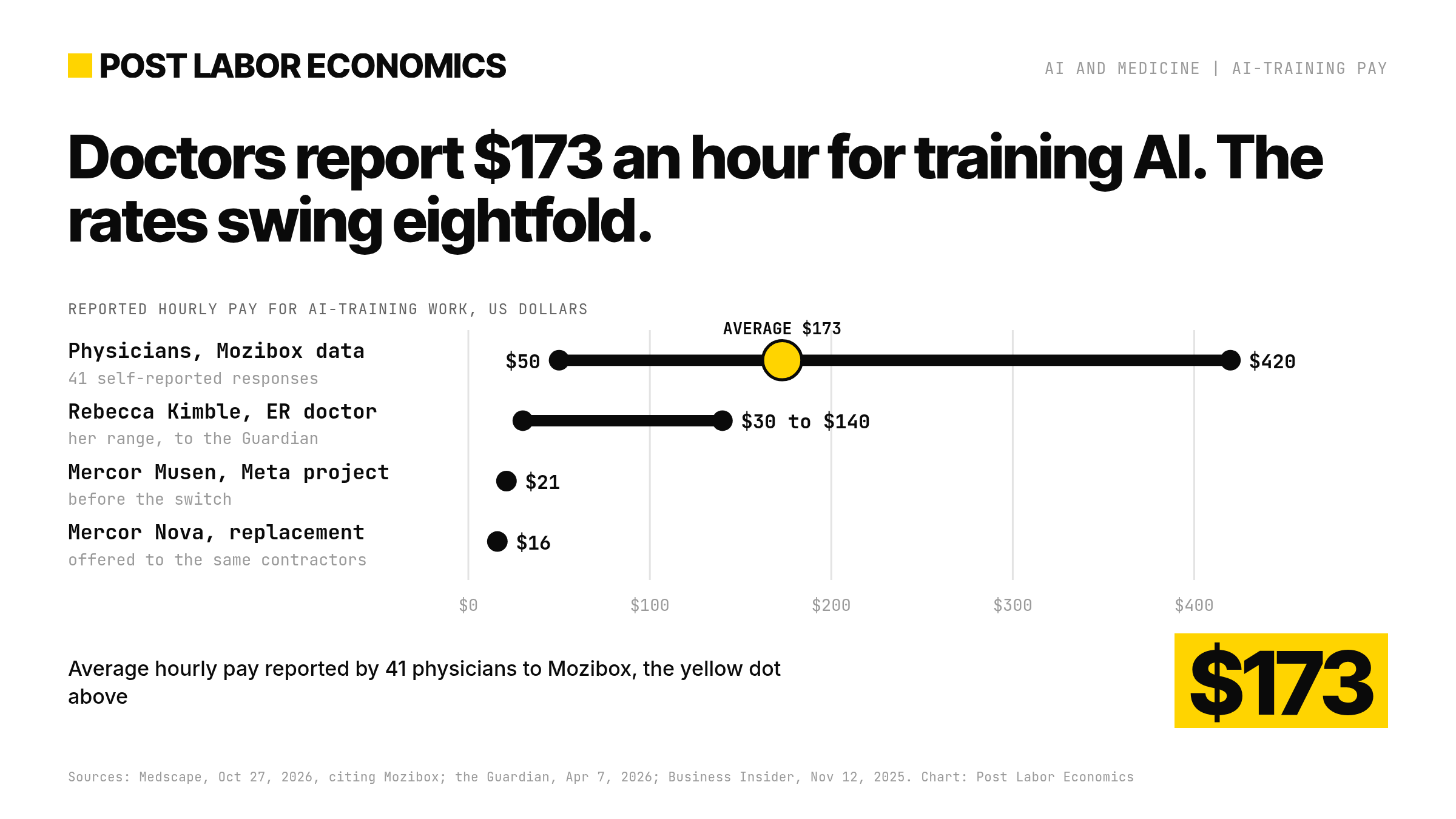
$173
Average hourly AI-training pay reported by 41 physicians to the career startup Mozibox, range $50 to $420 (Medscape, Oct 27, 2026)
For more than a decade, Rebecca Kimble worked as an emergency physician, from Indigenous reservations in South Dakota to a small town in rural Maine. “I enjoyed working where other people didn’t like to work,” she told the Guardian in April.
Starting in 2022, a run of setbacks kept her out of clinical work for more than two years. When she tried to come back, she kept getting rejected. Long gaps in practice make that hard, the Guardian noted, because hospitals prefer doctors who are actively practicing.
Her mentor suggested something new: training AI. So she started grading how chatbots answer medical questions, for several platforms at once.
The work showed up without warning and went to whoever logged in first. When she started, she sometimes woke at 4 a.m. to check for tasks.
“This is not a job,” she told the Guardian. “This is a gig.”
She was making $500 to $1,000 a month from it. She also took a part-time job as a veterinary technician at the clinic where she takes her dogs.
Who gets paid in the expert-data boom?
Kimble’s story lands in the middle of one of the hottest businesses in AI. Doctors were already used to side work: about 40% reported having a side gig in Medscape’s 2023 report. Companies such as Mercor, Scale AI and Surge AI hire doctors, lawyers, engineers and writers to grade chatbot answers and write the test questions that make them better.
The top-line numbers sound great. Krystal Lin, an occupational medicine doctor who co-founded a career startup called Mozibox, has collected pay reports from physicians who do this work. The average is about $173 an hour, Medscape reported in October.
That’s the number that goes in the headline. Kimble’s number is a lot smaller.
So the question is simple. When AI companies pay experts to teach their models, who actually gets the money, and is it a job anyone can build a life on?
The hourly rate and the monthly check
Mozibox’s dataset is small, just 41 physician responses.
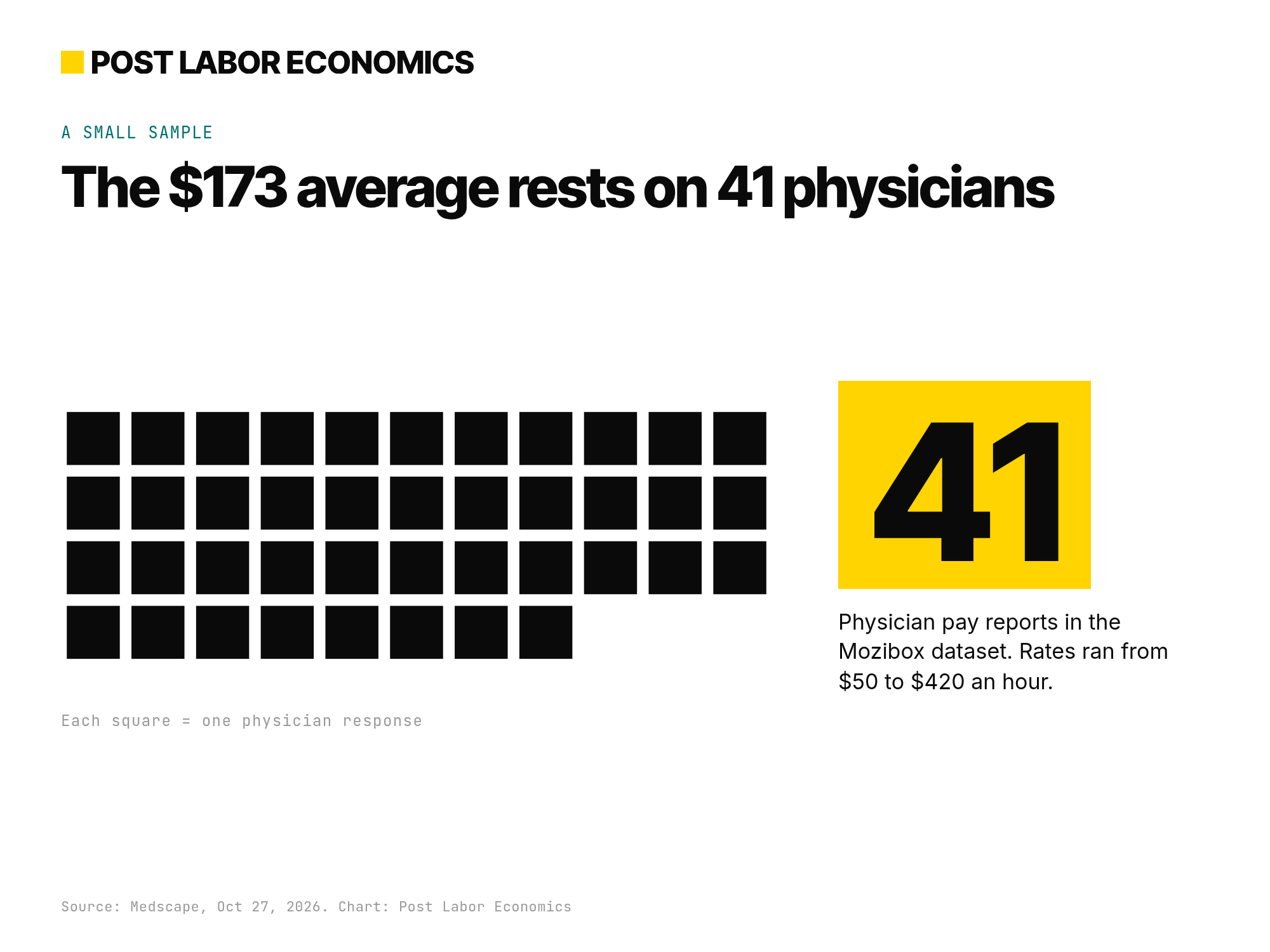
The reported rates ran from $50 to $420 an hour, and the highest came from radiology.
Kimble’s hourly pay ran from $30 to $140, she told the Guardian. That’s within the range. The problem was the hours.
She usually logged six to nine hours a week. Some weeks it jumped to 25 or 30. Other weeks, the work disappeared entirely.
Here’s the comparison that matters. In the ER, Kimble earned $300,000 to $500,000 a year, the Guardian reported.
Her AI work paid $500 to $1,000 a month.
Her AI work paid about 2% of what the ER did
U.S. dollars per month
How to read thisThe dark bar runs to the low end of her reported range, the light extension to the high end.
Derived estimate
2%
Her AI-training months paid $500 to $1,000. Her ER months paid $25,000 to $41,667.
Bar chart. Use the up and down arrow keys to move through 2 categories. A data table follows.
Emergency medicine (annual pay / 12): Low end $25,000, High end $41,667
Figure 1. Monthly pay Rebecca Kimble reported to the Guardian (Apr 7, 2026). ER: $300,000 to $500,000 a year / 12. Before taxes.
Source: The Guardian, Apr 7, 2026. Chart: Post Labor Economics Download CSV Methodology
Data table
ER pay of $300,000 to $500,000 a year is $25,000 to $41,667 a month (midpoint $33,333). AI-training pay was $500 to $1,000 a month (midpoint $750). At the midpoints, AI pay was 2.25% of ER pay ($750 / $33,333); across the ranges, between about 1.2% ($500 / $41,667) and 4.0% ($1,000 / $25,000). Her AI pay was capped by available work, not by choice: tasks went to whoever logged in first, she usually got six to nine hours a week, and some weeks there was none. These figures exclude her part-time vet tech job.
| period | Low end | High end |
|---|---|---|
| Emergency medicine (annual pay / 12) | $25,000 | $41,667 |
| AI training gigs | $500 | $1,000 |
An hourly rate tells you what a good week looks like. It doesn’t tell you how many good weeks you’ll get.
How typical is Kimble?
The Guardian found Kimble while reporting on skilled workers over 50 who turned to AI training after they couldn’t find work in their fields. It found the same pattern again and again, at much lower pay than a doctor gets.
Patrick Ciriello, 60, spent his career designing software systems. After losing his job, he sent hundreds of applications without an offer, and his family spent about four months sleeping in a Toyota Highlander, the Guardian reported.
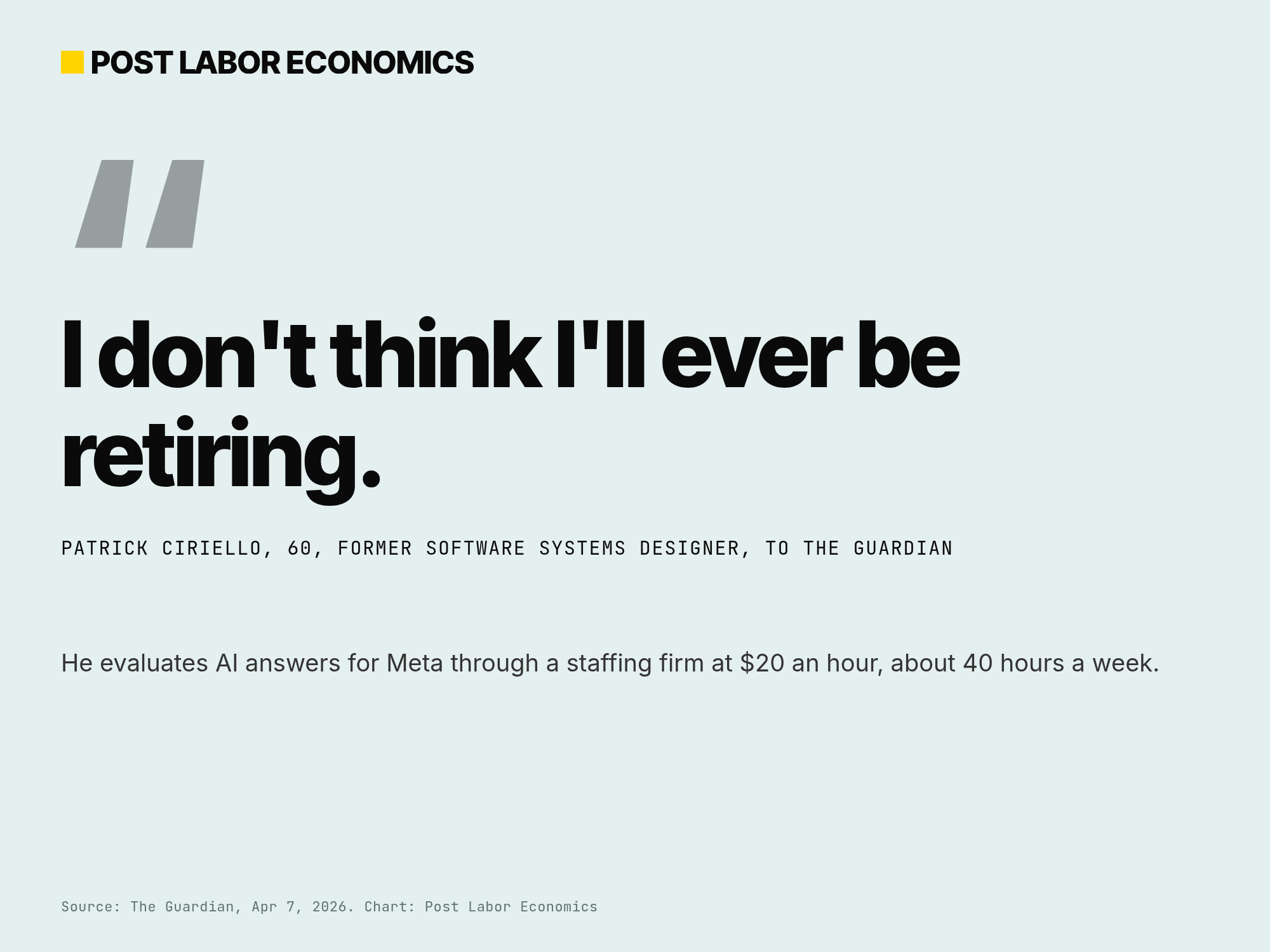
He now evaluates AI answers for Meta through a staffing firm, at $20 an hour, about 40 hours a week. His pay is low enough that he qualifies for Medicaid and food stamps.
“I don’t think I’ll ever be retiring,” he told the Guardian. His first AI training job, reviewing answers for Google’s models, ended in a mass layoff in January 2025.
Anne, 60, whom the Guardian kept anonymous at her request, taught occupational therapy doctoral students before long Covid pushed her out of the classroom. She went from a six-figure academic salary to $26 an hour training Google’s models, then was laid off.
She now trains Meta’s models through a staffing firm for a dollar an hour less. “It’s just devastating and demoralizing to think of all the time I spent on my career and the sacrifices I made to earn my graduate degrees,” she said. “Look where I’m at now.”
Most of this work pays far less than the doctor averages. According to job postings the Guardian reviewed, AI training gigs start around $20 an hour.
Pay rises from there into the $30s. Experts with in-demand skills can earn more than $100 an hour, the Guardian found.
And the rate can fall in the middle of a job.
Last November, Mercor ended a large Meta project called Musen and offered contractors a similar one called Nova at $16 an hour, down from $21, Business Insider reported.
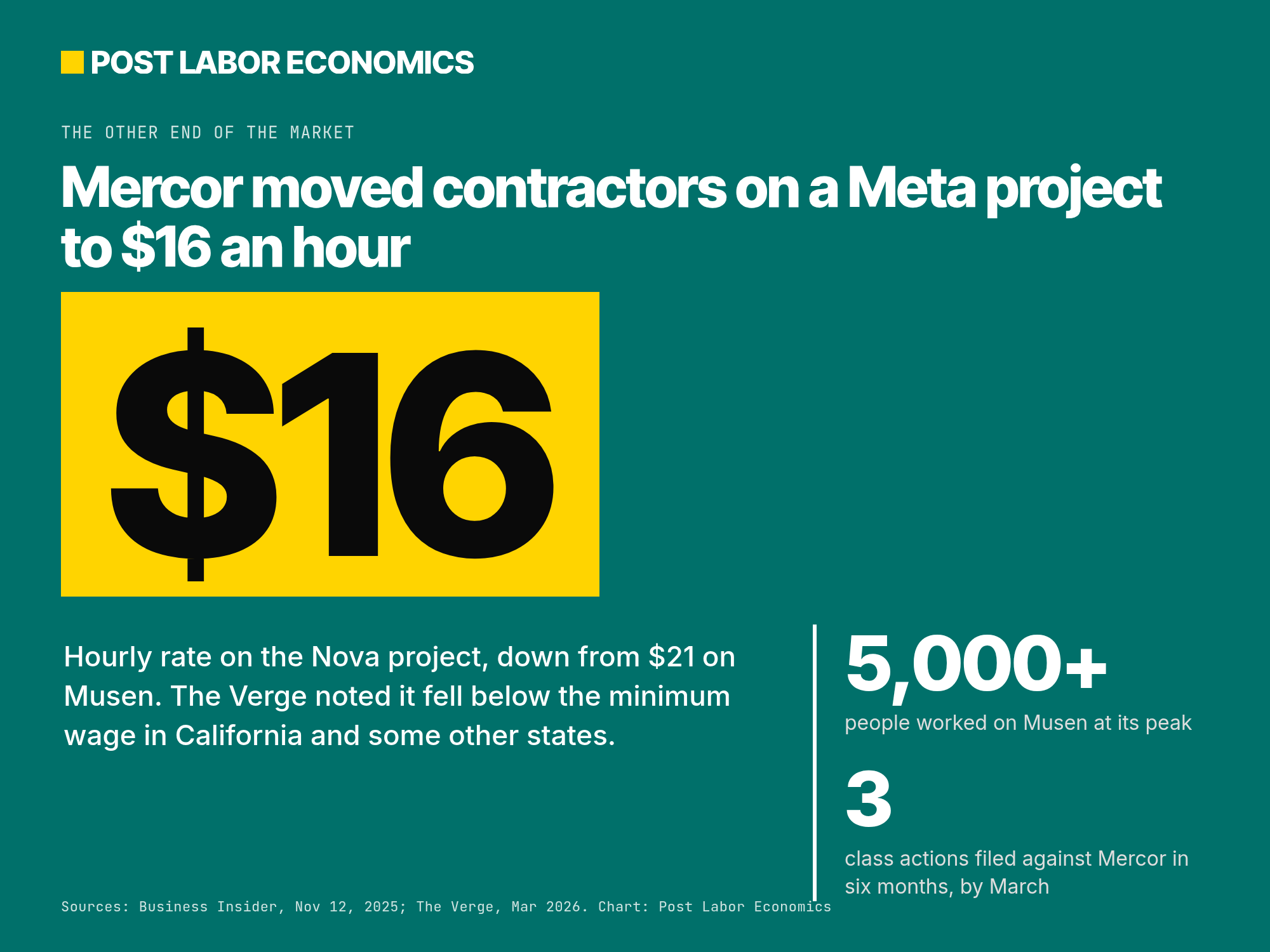
More than 5,000 people had worked on Musen at its peak, according to two people who worked on it.
Mercor’s email said the new rate was chosen to “offer greater earning stability and consistent access to work, rather than fluctuating opportunities.” One contractor told Business Insider it was the same tasks “but for $5 less an hour.” That’s one way to spell stability.
“We wanted to boycott this but are not in a financial place to do so,” the contractor said. “We needed to have the guaranteed income, even if it’s demoralizing.”
AI-training pay runs from $16 to $420 an hour, depending on who's asking
U.S. dollars per hour
How to read thisEach line spans a reported low-to-high hourly rate. A single dot is one reported rate.
26×
The gap between the lowest ($16) and highest ($420) hourly rates reported.
Bar chart. Use the up and down arrow keys to move through 7 categories. A data table follows.
Physicians, Mozibox dataset (avg $173): Low $50, High $420
- Mozibox survey average: $173 an hour (41 doctors)
- More than 4× the top entry-level rate of $40
Figure 2. Reported hourly pay for AI-training work, by source. Self-reported and company-stated, not a random sample.
Sources: Medscape (Oct 27, 2026); The Guardian; Business Insider. Chart: Post Labor Economics Download CSV Methodology
Data table
Mozibox dataset, 41 physician responses: $50 to $420, average $173 (Medscape). Kimble: $30 to $140 an hour (Guardian). Entry-level gigs start at $20, rising to $30 to $40 (Guardian). Ciriello: $20 (Meta evaluation work; earlier $21 for Google). Musen: $21; Nova: $16 ($5 less) (Business Insider). 420 / 16 = 26.25. 173 / 40 = 4.33.
| who | Low | High |
|---|---|---|
| Physicians, Mozibox dataset (avg $173) | $50 | $420 |
| Rebecca Kimble, ER physician | $30 | $140 |
| Entry-level AI training gigs (job postings) | $20 | $40 |
| Patrick Ciriello, Meta evaluation via staffing firm | $20 | $20 |
| Mercor Musen project (Meta) | $21 | $21 |
| Mercor Nova replacement project | $16 | $16 |
| Mercor platform average (CEO claim) | $95 | $95 |
A Mercor spokesperson called the outlet’s information “inaccurate” without saying what was wrong. The company also said it is “transparent” that the work is “temporary, project-based work.”
The inside view is worse. The Verge’s Josh Dzieza interviewed more than 30 of these workers for a March feature with New York Magazine. Nearly every one reported that demands went up, time limits shrank and pay fell as projects went on.
Lindsay, a graphic designer and illustrator in her 50s, said 85% of her design work had evaporated over the past year. She believes generative AI was the cause. She signed up with Mercor anyway.
Like most workers in the Verge story, she used a pseudonym. “I swallowed my hatred and signed up,” she said.
She worked on the Meta project that ended in November and was invited to Nova. “I have never, ever been treated as badly as this.”
When Nova’s pay dropped to $16 an hour, the Verge noted, it fell below the minimum wage in California and some other states. By March, three class-action lawsuits had been filed against Mercor in the previous six months, the Verge reported, all arguing that its workers are misclassified as contractors.
Kimble put the doctor’s version of this more politely to Medscape. “Projects start, they stop, they get funded, they stop the funding,” she said. “That unpredictability makes it a lousy full-time job.”
Who gains
The companies in the middle are doing very well.
Mercor says it crossed $1 billion in annualized revenue run rate earlier this year, according to its own blog in May.
It says it pays out more than $2 million a day to more than 30,000 weekly active contractors.
Mercor was valued at $10 billion last year, which made its three founders the world’s youngest self-made billionaires, the Verge reported.
Mercor’s CEO, Brendan Foody, sees a bigger payoff.
“We need to cure cancer. We need to solve climate change,” he told CNN. “And making everyone 10 times more productive so that they’re able to better work on those key problems is going to be a huge, huge benefit.”
The AI labs gain too. They get expert judgment by the task, without salaries, benefits or a promise of next month’s work.
Some experts gain as well. The Verge spoke with a playwright making $10,000 a month. Doctors like Lin treat it as side income on top of a practice, which is what she recommends.
“Approach these projects as supplemental work, with realistic expectations about continuity,” Lin told Medscape.
The work is global. Mercor says it pays experts across dozens of countries and currencies.
I couldn’t find consistent pay data by country, so I can’t tell you whether a doctor outside the U.S. is paid like one inside it. That’s a gap in the evidence.
There’s another risk, built into the work itself. The Verge described a worker with a master’s in linguistics who wrote test questions designed to stump the models.
Late in 2025, the models got harder to stump, his output dropped and the project ended. When he looked for the next gig, the listings wanted medical experts, HR managers and teachers. He’d been without work for five months when the Verge spoke to him.
The Verge’s reporting points at one more risk. A lawyer suing Mercor and other data platforms told the outlet that unlike Uber drivers, these workers can be replaced by people anywhere who will work for less.
Why Kimble still did it
None of this made Kimble an AI skeptic. “Now is the time to try to get it right in whatever small ways we can,” she told Medscape.
She worries hospitals could use better AI to cut the number of doctors on staff, the Guardian reported. But she thinks doctors should help shape it, especially as more patients turn to chatbots for health advice.
“I don’t think it is the enemy,” she said. “I think it’s inevitable.”
In my opinion, she’s right on both counts, and her story shows why the work matters and why it can’t carry a career.
Expert data is real work, and the models are better for having doctors grade them. But the pay is set by the project, the project is set by the lab, and nobody in that chain has promised the doctor anything.
My limit: the best pay data here is a 41-person survey and a handful of interviews, and I’d change my view if a platform published what its experts actually earn in a typical month.
In a 2022 podcast conversation with John Flanagan of CareerSource Tampa Bay, I said, “There’s an incredible amount of dignity that you get when people can take care of themselves and their families.” An hourly rate that shows up some weeks and not others doesn’t give you that.
Where Kimble is now
By October, Kimble had moved to Germany with her husband, who is on active duty, Medscape reported. Finding clinical work overseas proved hard, and AI training became her main job.
Now she’s going back. Medscape reported that she is returning to the U.S. and to work as an ER physician.
Her advice to other doctors thinking about it: “Don’t quit your day job.”
My recommendation, if you’re an expert being recruited for this work: before you take a project, ask the platform how long it is expected to run, how many hours a week you can count on and whether the rate can change midway. Write down the answers, and treat any project with no answer as a side gig, whatever the hourly rate says.